Friday, April 12, 2013

Anaheim WonderCon 2013

Friends, readers, straggling passersby!  Anaheim WonderCon ended twelve days ago, and twelve days is an awfully long time to hold off on writing about it.  If I were a journalist or something, I'd have some 'splaining to do.  But forget all that: we all just want to see words and pictures, right?
Yours truly, looking less intimidating than Aquaman.
I've been a stranger from the convention scene in recent years.  My last San Diego Comic Con was back in 2010, and my most recent con was a small affair in Seattle two years ago called Sakura-Con.  Conventions, being generally held far away from where I live and designed to part me from my funds, are a demanding hobby, but they are usually worth it for the memories and the swag.  This year I've had plenty of both, thanks to my girlfriend Tara, whose idea this trip was.

And yes, it was trip.  Last year I told myself I was done driving all the way from Oregon to Southern California and back.  I was clearly wrong about that, as Tara and I found ourselves barreling down the 5 in the Mighty Muskrat once more.  I taught her to drive stick for the trip, and honestly it probably saved my sanity.  Which I needed, because cons are nuts.

So, a bit of background.  WonderCon is much like Comic Con; in fact, they are put on by the same company.  The difference is primarily of scale.  While San Diego Comic Con hosts roughly the entire population of Hollywood alongside an uncountable host of nerds with the wherewithal to buy impossibly scarce passes, WonderCon exists within finite dimensions and can be thoroughly explored even by a relative newcomer to the convention scene.

We reached Anaheim on March 29th, and as a Southern Californian, Anaheim means primarily two things to me.  One, the Angels play there (regardless of what they might want you to think).  Two, Disneyland is there (and going there would cost nearly as much as the whole trip).
Seriously, we walked past it every day, and never went.  Ten year old me would never understand.
But inside the Anaheim Convention Center were pleasures of another kind altogether.  At last I was reunited with my people, the nerds, and it felt good.  This was Tara's first convention, and I wanted her to share in its atmospheric joys: the sounds, the costumes, the swag, and the myriad opportunities for events hitherto thought impossible.

It certainly helped matters that within hours of arriving, we had met Amber Benson (from Buffy the Vampire Slayer, Tara's favorite show) and had secured an autograph and a photo opportunity.  I don't want to say the con peaked for us on the first day, but it was definitely a highlight.
On the left, Tara quietly freaks out.  On the right, I try not to act like a dork.
As I mentioned before, WonderCon is a smaller to-do than Comic Con.  It's evident from the exhibit hall alone.  The last time I was at SDCC, the exhibit hall was packed to capacity with booths and the accompanying throng.  In Anaheim there was room to spare; enough even to use part of the floor as a queuing area for panels in the arena.  As much as I used to love going to Comic Con, WonderCon's (comparatively) more relaxed style suited me (and Tara) far better.  The sheer size and spectacle wasn't there, but the heart of nerd-dom beat fully on display in Anaheim that weekend.
Tara gives the order, and my joy goes to warp nine.
It's not quite right to say that WonderCon is less commercial than its sell-out sibling to the south, even though it is undoubtedly true.  It's a moneymaking operation and entertainment, rather than "art," is the key component.  But it's just so much easier to breathe in an environment like WonderCon, and with fewer noisy stimuli it's easier to focus in on the really worthwhile moments that come your way.

Like when a fully mobile R2-D2 rolls out of your childhood and validates your life.
WonderCon is small, but it isn't tiny.  On three separate occasions we missed getting into panels we wanted to see on account of lines, not to mention seat-holders who didn't leave when the events they were watching had ended.  We stood, and sat, and did our best to simply exist in a lot of lines.  When we missed out, we cursed our luck, but we got smarter as the weekend passed and tried to keep ourselves happy.
Reading Harry Potter and the Order of the Phoenix while waiting for a panel to start.
 One particular source of joy was the artist's alley, where the real stars of the show were selling their wares and generally validating every experience we had.  It kind of sucked that we missed out on the over-stuffed Adventure Time panel (on account of every con-goer's nemesis, the Fire Marshall), but I did purchase an awesome print from an artist by the name of Nicole Sloan, and what could make me happier?  Nothing, really; it's a beautiful picture, and it's that thrilling sense of meeting genuine creative people and having conversations with them that helped make this one of the most special conventions I'd ever been to.

In fact, mainly due to Tara's influence, I approached more "famous people" this time around than I've ever dared to do in the past.  We had two honest-to-goodness conversations in two days with writer Frank Beddor, author of The Looking Glass Wars.  And we met Jane Espenson, writer and producer of just about every awesome TV show.  She signed Tara's Buffy poster, and drew a heart with a stake through it.  She might be the best person ever.

Oh and also, we got to sit in the same (enormous) room as Joss Whedon and the cast of Much Ado About Nothing.  There was much rejoicing, and the fact that Nathan Fillion cancelled at the last minute hardly seemed to matter.  Well, it made us very sad, but we were really too nerd-thrilled to mind.
A small fraction of what was clearly the best panel at the show.
Celebrities get the headlines, but of course they aren't the best thing to look at in a nerd convention, no matter what their egos may tell them.  Cons are the land of cos-play, and cos-play is a wealthy source of awesome times and brilliant, slightly-unhinged people.  Our award for best-executed costume would have to go to the fellow who gave up visibility and freedom of motion to walk around sideways all day behind an articulated Paper Mario costume.  Mostly because he took the best pictures with us.
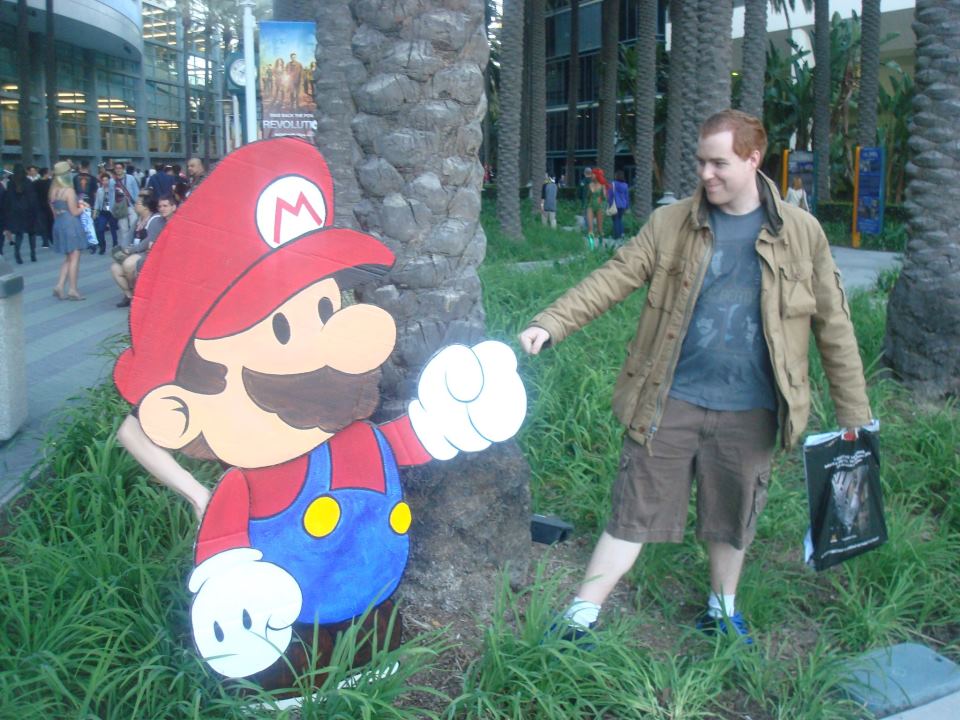
Shine on, you paper diamond.
All our dreams fulfilled, we departed Anaheim on the 31st, staying with my mom in San Diego for a few days before returning home, swag bags in tow.  Our mission, such as it was, was a resounding success.  Tara had enjoyed her first con, and I was already looking forward to the next.

Putting on a successful convention is tricky business.  San Diego Comic Con is memorable and astonishingly well-executed for all that's going on (at least it was three years ago), but its sheer size means that you can end up feeling lost and over-stimulated.  On the other end, a smaller show like Sakura-Con can have a lot of heart, but waste its potential due to frustratingly low production values and amateur management.  WonderCon's balance was beautiful, and I know part of me is just happy to have gotten to share it with the girl I love, but even so I have to say I had a fantastic time.  I don't know if we'll be back next year, but it would definitely be worthwhile.

Wednesday, March 27, 2013

Waw: The Mystery and Beauty of Alphabets

I don't know if most people have a favorite letter of the alphabet.  It seems like the sort of eccentricity that only someone who thinks about language a lot would have, especially if they took their favoritism very, very seriously. 

As a matter of fact, I take mine so seriously that I can't even settle on one particular letter.  I can only talk about my favorite class of letters (they come in classes, you see).  Namely, that numerous class derived from Waw, a letter of the Semitic alphabets of the ancient world.  The multiplicity of Waw is a feature of written language that never ceases to amaze me.  As a student of history and language, I though it might be interesting to share with you all the remarkable story of how one symbol took on an unusual role in the development of our alphabet.

So, you ask, what the heck is Waw?

For starters, it looks like this:

Phoenician Waw
Or, at least it did in its Phoenician form, the most direct influence on the alphabets of Europe.  It looks somewhat different in Hebrew and Arabic and the other Semitic alphabets, but for those of us who write with the Latin alphabet, this is our Waw, and we can put the others aside for the time being.

How do we say "Waw?"  It's a difficult question.  In modern times it's usually called "Vav," because the sound it makes in present-day Hebrew is equivalent to that of the letter V.  But in ancient times, it would have sounded more like the English word "wow," and indicated the sound of W.  For historical purposes, I prefer to say "wow," but you don't have to!  It's your choice.

So we begin our tale with Phoenician Waw, which as I have said, was pronounced like W.  English-speaking readers will note, however, that the letter it most resembles is Y.  This is not a coincidence.  Waw's descendants in the alphabets of Europe have not only adopted many shapes, but also a startling number of sounds.  Across the ages, you can find Waw-letters in many languages representing all of these sounds (and more), here represented in the international phonetic alphabet*:
  • /w/ - the consonant sound of English "wow."
  • /u/ - the vowel sound of English "food."
  • /ju/ - the consonant/vowel combination sound of English "you."
  • /i/ - the vowel sound of English "feed."
  • /j/ - the first consonant sound of English "yellow."
  • /y/ - a vowel sound not usually found in English: pronounced like the vowel in "feed," but with the lips rounded as though it were "food."
  • /ʌ/ - the vowel sound of English "strut."
  • /ai/ - the sound of the English word "I."
  • /v/ - the first consonant sound of English "van."
  • /f/ - the first consonant sound of English "fan."
  • /b/ - the first consonant sound of English "ban."
And that's not even a complete list!   There's simply no denying that Waw has been an extremely adaptive symbol.

In school, we are taught early on that the twenty six (or so) letters of the alphabet all stand for a sound, and it's this function that allows us to read words, even if we've never seen them before.  This is called the Alphabetic Principle: one letter or one combination of letters makes a particular sound.  Experience tells us otherwise: English in particular often has a haphazard relationship between its letters and its sounds.  The story of Waw is the great example of the challenge inherent in designing a perfect alphabet: the demands of many languages and the passage of time can distort the sounds and shapes of letters in ways that can hardly ever be predicted.

*- The international phonetic alphabet symbols listed here are not necessarily Waw-letters themselves.  For instance, the IPA symbol for the first sound of the word "yellow" is /j/, which is not derived from Waw.  The letter Y, however, is derived from Waw, and is the letter used in many languages to indicate that sound.  The distinction between letters and sounds is very important to understanding how both can change!

The Early Adventures of Waw

The Semitic alphabets, including Phoenician, are actually what we call abjads.  They have symbols for consonant sounds, but not vowels, which are indicated by other means, or not indicated at all.  This works fine for Semitic languages, where most related words have similar patterns of consonants.  But it didn't work for the Greeks, who created their own alphabet on the Phoenician model, back in the 8th century B.C.

Phoenician Waw had one principal sound: /w/.  From Waw, the Greeks fashioned two distinct letters: one for the consonant sound, and one for a vowel, specifically the vowel /u/.  The vowel was written as Υ, and came to be called Upsilon.  The consonant was slightly modified in shape, becoming Ϝ.  This letter was pronounced as /w/, just like the original Waw.  In fact, its name was originally Wau, but later on became widely known as Digamma (because of its resemblance to the letter Gamma).

This was the first time Waw was split into multiple letters, but it didn't last in Greek.  Within a few centuries of the alphabet's creation, the sound /w/ had disappeared from the Greek language.  When that happened, the need for Ϝ disappeared, and Ϝ was eventually dropped from the standard version of the alphabet.  To this day, Υ remains the only Waw-letter in the Greek alphabet.
Upsilon, upper and lower case.
That might have been it for Waw in Europe (at least as far as the shape goes), but adapting an alphabet to the needs of another language is a tricky thing, and Υ alone was not sufficient for the needs of the people of central Italy.

International Waw

Pottery with an early version of the Greek Alphabet: Upsilon is the fourth letter from the right on the second row.
Latin and Greek are (and were) in many ways similar languages.  They are both descended from a common Indo-European ancestor and their core vocabularies are much alike.  However, their sets of phonemes, or language sounds, had largely diverged by the time of the alphabet.

One of the most obvious differences was that the ancient Greek language did not have the sound /f/, while ancient Latin did.  Modern Greek does have /f/, and it is written with the letter Φ (Phi).  However, Φ had a different sound in those days: similar to the English letter P, but with a strong puff of air behind it.  In those early days, the Latin speaking Romans had no obvious use for Φ, but they did need a letter for /f/.

The Romans' neighbors, the Etruscans, had an ad-hoc solution.  Their alphabet was based on a very early version of the Greek, and still included Ϝ as the symbol for /w/.  For reasons known perhaps only to the Etruscans, they had decided to use the letters ϜH to represent /f/.  Dropping the H, the Romans rescued F from oblivion and assigned it the value we recognize today.

Of course, the use of F for /f/ meant that it could not be used for /w/.  The Romans, however, did not mind this.  To them, the sounds of the consonant /w/ and the vowel /u/ were similar enough that one letter could serve for both of them, and nobody was likely to be confused.

For that, the Romans simply adopted Υ from the Greek/Etruscan alphabet, only they simplified it slightly.  Removing the letter's lower stem, their new letter was written as V.  Its name was pronounced /u/ (as in "ooh") and depending on context it was either a consonant or a vowel.

Therefore, by the time of the Roman Republic, the Latin language was using two Waw-letters, F and V, to represent three distinct sounds: /f/, /w/, and /u/.  Waw, of course, was only just beginning its productive mutation into further shapes and sounds.

Imperial Waw

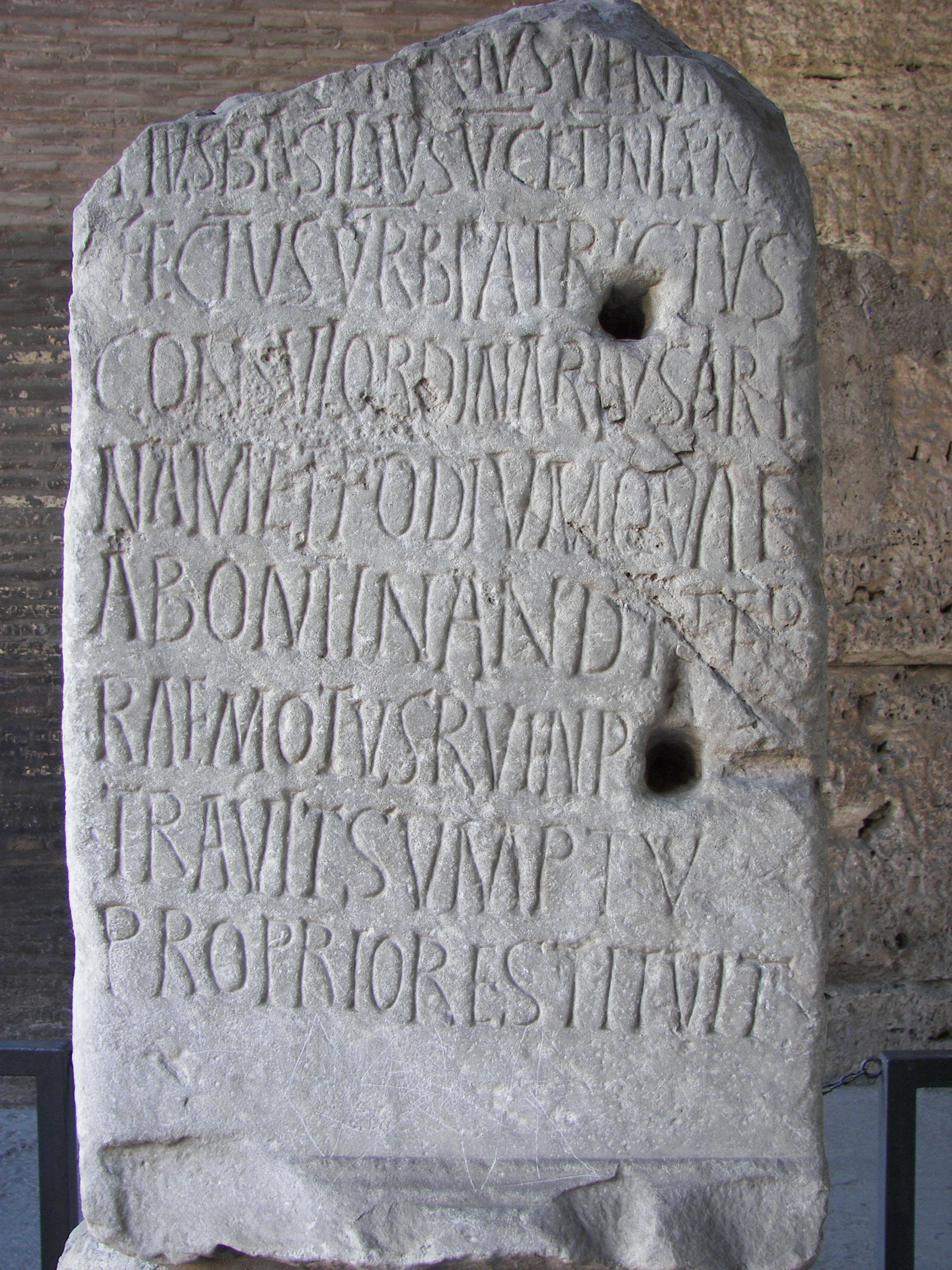
Inscription from the Coliseum: both V and F are found here, but V is far more common.
After the Romans began conquering everything they could see, they added the Greeks to their massive empire during the first and second centuries B.C.: the very people who had provided the foundation for the Latin alphabet.  The Romans admired Greek culture, and actively imported it into their own society, borrowing myths, philosophical and scientific concepts, and everything else they could get their hands on.  Naturally, this meant borrowing a great many Greek words into Latin.

Since the Latin alphabet was based on the Greek, it might seem as though writing Greek words for a Latin audience would be easy.  Actually, the Greek language had changed significantly since the creation of the alphabet, in ways that the Romans couldn't immediately adapt to.

One of the most dramatic changes involved the Greek letter Υ, or Upsilon: it no longer represented the vowel sound /u/ in spoken Greek.  After a few centuries of changing pronunciation, it stood for the sound /y/.  As described above, this vowel is like trying to pronounce the word "feed" with your lips rounded as though it were "food."  The letters Υ and V were therefore no longer equivalent to each other, and there was no obvious combination of the other Latin vowels that would carry the same sound.

So the Romans went a step further from borrowing words and borrowed some letters.  They introduced Y to their own alphabet as a sixth vowel, to be used only for writing the sound /y/ when it occurred in Greek words they had borrowed (such as systema or physica).  They called the letter "Y Graeca," to emphasize its foreign origin, and most Latin speakers had difficulty distinguishing its sound from the sound /i/, which they wrote with the letter I.  Eventually the letters I and Y were regarded as more or less interchangeable.

Thus, by the height of the Roman Empire there were three distinct Waw-letters (F, V, and Y) representing five distinct sounds (/f/, /w/, /u/, /i/, and occasionally /y/) in the Latin alphabet.  As more and more time and distance passed between the Phoenicians and later civilizations, the identities of Waw and its progeny were growing more and more distinct.

The Romances of Waw

The Roman Empire was a large place, and its vast territory supplied ample room for the Latin language to spread.  Many of the languages of Europe, particularly of the western Mediterranean region, are direct descendants of Latin; most of the other languages have adopted many of its words.  The alphabet followed in its wake, and today is used by languages from many language families all over the world.
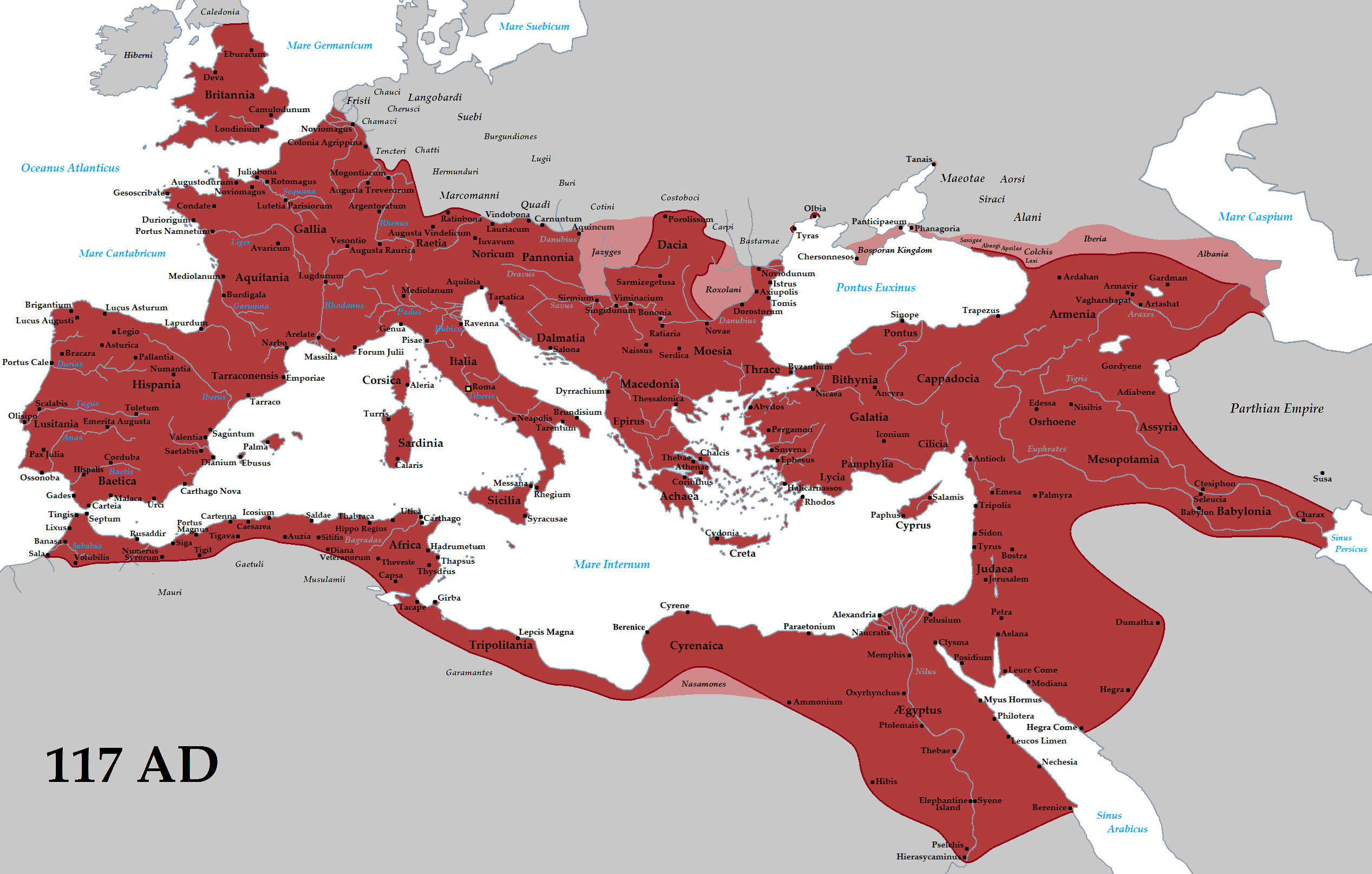
The Roman Empire at its Largest
But the Empire fell in the fifth century, in part due to over-extension.  Over such a large area and across many centuries, the Latin language also underwent numerous changes.  Different changes took place in different provinces, which accounts for the differences that exist among the Romance languages today, such as French, Italian, and Spanish.  But there were some changes that were more or less universal, and affected not only particular Romance languages, but Latin as it continued to be used by the Catholic Church, and the writing systems of many other languages.

The letter V began to take on the sound English speakers associate with it today, /v/, as the Empire grew older.  In some regions, as in modern Spanish, it even changed to /b/.  Changes in pronunciation happen to languages all the time, and are usually denounced by authorities of the older generations even as the youth take them up with hardly a care.  Many of the sounds of Latin were changed over the years, but the change from /w/ to /v/ is one of the most obvious and dramatic.

The use of V to represent /v/ presented some difficulty for writers, especially for those attempting to write down words from Germanic languages such as English, where the sound /w/ was still common.  As V became more strongly associated with /v/, a substitute symbol was needed.  Many writers used a symbol from the old Runic alphabet, Ƿ, which was called Wynn.  But others began writing the sound by putting two V's together, as VV.  By the medieval period this combination had developed into the new letter, W; it wasn't used much in Latin or the Romance languages, but it remains integral to the Germanic languages.

The other main problem presented by the change to the sound of V was that it became much easier to confuse the sound of the consonant form with the vowel.  A new form, U, appeared during the middle ages, but it was not used the way it is now; in fact, it only ever appeared in the lower case.  The basic rule was this: V was used at the beginning of a word (or if the entire word was written in capital letters), and U was used in the middle of the words.

This, of course, did not make anything clearer, as it led to bizarre spellings like "vniuerse."  But it wasn't until the sixteenth century that U was widely regarded as a separate letter and a clear vowel/consonant split was established.  Whatever the reason for inventing the letter U, it doesn't seem to have been to make things easier for readers. 

Indeed, by the time U was established as an independent letter, many languages required more of it than to represent just /u/.  English put, cut, and fuse each contain different vowels, and none of them is simply /u/.  The French use U to indicate /y/ and the combination OU to indicate /u/.  In languages with more than five vowels, the Latin letters have had to pull double, triple, and sometimes quadruple shifts.

As a result of all this, the standard Latin alphabet entered the modern age with twenty six letters, five of which were ultimately derived from Waw: F, V, Y, W, and U.  Together they indicate at least ten different sounds in Modern English, and several more across other languages.  New letters haven't been introduced for quite a while, and aren't likely to be now that spellings have been widely standardized, but old Waw has done quite well for itself over only a couple thousand years!

Waw in Modern Times

Fully nineteen percent of our standard alphabet comes from the single letter Waw, more than from any other semitic letter.  But from a strictly practical perspective, that is irrelevant.  Alphabetic symbols are by their nature entirely arbitrary.  The Latin letter P is almost identical to the Greek letter called Rho, but they have completely different sounds.  The shape of the letter doesn't have anything to do with the sound it makes: that's just a convention that we all have agreed upon in order to make reading possible.

An alphabet is a tool: a way to speak when our mouths are otherwise unavailable.  The symbols are analogues of particular mouth configurations, and it's up to the speakers of a language to determine at any given time what the precise conventions are.  And the history of Waw-letters, convoluted as it is, demonstrates how changing conventions can alter the identity of letters, even though we're taught in school to think of them as a sort of unchanging, received legacy.  Small wonder the rules of English spelling don't seem to make sense!

In two hundred years time, your descendents will speak an essentially different language, and there's no guarantee that F, V, Y, W, or U will mean the same sounds to them as they do to you.   And there's no guarantee they won't be using any newly invented letters.  They might even be further derivations of Waw.  But they might not.

My Favorite Letters

Alphabets are arbitrary, so is language itself, not to mention the ideas we use our gift for language to express.  I could have written about anything at all, but today I wrote about alphabets and letters.  I thought they could use a little extra appreciation.

I like the Waw letters, especially W.  Part of that is just the aesthetics of the sound, and that's just personal preference.  But the productivity of Waw and the ease with which it has been adapted to different linguistic needs is exceptional.  There was nothing particularly different about this letter that marked it out from the rest: unpredictable history took its course, and left the story in its wake.

People talk sometimes about spelling reform, or a new alphabet for our language that actually fits its pronunciation.  I even took a rather pathetic crack at designing one myself.  But I love the system we have, with its unpredictability and its historically-informed lunacy.  And as long as we can still read it, I think the argument that we need a new one is fundamentally weak.
__________
All pictures taken from Wikipedia

Wednesday, March 20, 2013

From Good Will Hunting to Argo: How Ben Affleck Recaptured Hollywood's Heart

The following is a guest post by Eve Pearce

When Ben Affleck claimed the Best Picture Oscar a few weeks ago it was a far cry from his first Academy Award win. Many commentators enjoyed the comparison of a youthfully exuberant actor on the cusp of career and stardom with his older, wiser self; many others failed to even make the connection. Yet Affleck’s original screenplay prize, shared with childhood friend and fellow actor Matt Damon, was heavily lauded, applauded as well as derided at the time. It may be hard to believe, but it was fifteen years ago that the two bound joyously and enthusiastically onto the stage to thank their mothers, wearing tuxedos that seemed ill-fitting in more ways than one. Both have achieved highs in their careers, but only one has suffered the bitter backlash of fame and that is the current toast of Hollywood, Affleck. But how did a film about a maths genius from Boston charm the Academy and pave the way for Hollywood success? Indeed, was this seemingly small-budget and heartfelt emotional drama in fact a cynical attempt to capture both awards and fame for its two young stars?

A leading man with a difference

It’s difficult to imagine the pitch of this film, let alone anyone biting for the rights. Let’s face it, mathematics is hardly considered the stuff of Hollywood gold - add to that two first time screenwriters, a less than glamorous location and a relatively obscure director and it is hard to believe the film was ever made. However, confining Damon’s character of Will Hunting to the pigeon hole of ‘maths genius’ is unfair to the piece as a whole. It is a characteristic symbolic of far more than numeric skill and significant in many ways. His God-given talent is his curse, instead of heralding the promise of a brighter future it seems to further instil feelings of worthlessness in him as even his genuine genius fails to raise him from the low aspirations his unpleasant upbringing has created: highlighted by the memorable image of Will working as a janitor whilst simultaneously solving the most complex of sums. His experience of the world of education reveals to him a different world from the one he has known. Mountains of mathematics textbooks, chalk board cliff faces and rivers of intellectualism represent a better world, with better people and better prospects. In a film that is unafraid of liberal ideals the notion that education is the key to bettering yourself rings ear-piercingly true. 

On a more distrustful level, there is no mistaking the purpose of Will Hunting’s given skill. Damon and Affleck would have known to steer clear of making their protagonist a sportsman or an artist. One is almost too admirable in its implications of strength and physical prowess and the other, in terms of filmic conventions at least, too individual and introverted. When baiting Oscar, it appears characters with more unusual issues are required. Ricky Gervais’ comedy Extras, which featured a number of celebrities playing skewed versions of themselves , though often wide of the mark in its observations got it absolutely spot on when it came to the Academy and their penchant for certain cinematic tropes. Kate Winslet, then a multiple nominee but also a multiple loser at the Oscars, explains clearly to Gervais’ character what must be done in order to win an acting gong at the ceremony – her theory revolves around the perceived ‘worthiness’ of character and subject. Or in her unreservedly politically incorrect terms, ‘You’re guaranteed an Oscar if you play a mental.’ Strangely enough, her eventual win saw her portray an unhappily illiterate woman in The Reader … and in Good Will Hunting’s year, Matt Damon lost out as Best Actor to Jack Nicholson as a man with obsessive compulsive tendencies and a deep-rooted social ineptitude in As Good As It Gets. Perhaps she had a point.

Movie magic

The image of the two soon-to-be stars carefully crafting their love song to the nurturing of undiscovered talent raises a surprisingly rarely posed question: why have the two not written together again? As images of Damon and Affleck, fresh-faced with golden statuettes in hand, were beamed around the world, a number of fun-sapping sceptics dared to suggest that the whole thing was a sham. In fact, they purported, Damon and Affleck did not compose the script at all. The implication that they were the far more pretty and acceptable face of the true writer of the piece was far from welcomed by Miramax, the Weinstein powered company behind the film’s distribution. Understandably so, as it had been a key component of a highly successful marketing scheme orchestrated by Weinstein and friends. It must also be noted that the two have written again, just not together. So perhaps Good Will Hunting was as baffling an equation as those that the eponymous hero solves with ease – quite simply a case of right place, right time for Damon and Affleck.

Affleck himself did not fail to notice the significance of his return to the winners’ enclosure. His acceptance speech was warm and as genuine as an actor can deliver. Following Good Will Hunting’s success, Affleck appeared distracted by fame: he made terrible choices both personally and professionally (with Jennifer Lopez as the common denominator – sorry J-Lo!) before regaining his equilibrium and re-establishing himself as a rare filmmaker: one who has something to say. Choosing to believe in Good Will Hunting’s authenticity in terms of its authorship in addition to its purpose means choosing to believe in the magic of the movies and choosing to believe in the alchemy of filmmaking. Furthermore, it makes Affleck’s current success all the more remarkable, as a man who has seen his career go full circle it almost sounds like the premise of a movie script that has yet to be written.

Now wouldn’t that be the perfect reason for Affleck and Damon to reunite?

Sunday, March 17, 2013

Poetry Jam #11

Poetry is a fine hobby, and it can be approached from many angles and still be successful.  You can look at the process of writing poetry as though it were like constructing a meticulous puzzle, or following dreamily along with a rhythm, or confessing all your most urgent feelings.  There are other ways to write poetry, of course.  But you can't expect me to list all of them, can you?  There really are a lot.

Writing a good poem is deeply satisfying, and writing a merely OK poem is pretty cool, too.  Bad poems aren't as fun to have around, but sometimes you can't help but turn an interesting idea into something nobody ever wants to look at again.  Thankfully, ideas keep coming regularly.

These poems date roughly from last spring until August.  I am sure of that last date, because I finally got the bright idea to write dates on my poetry last year.


Cold War Boils Over

The bombs will fall on Russia
far, far away,
the bombs will fall on China
very far away;
the bombs will fall on North Korea,
Germany, Japan,
the bombs will fall on Washington some day,
When world war has come to the USA.

The bombs will fall on Wall Street,
far, far away,
the bombs will fall on Main Street,
very far away,
the bombs will fall on Pennsylvania
Avenue at dawn,
the bombs will blow us very far away
when world war has come to the USA.


The Moon Unraveled

The moon was wound too tight and came undone;
the strings and leather fell to Earth in such
cascades they shuttered out the evening sun,
and darkness fell around the tumbling sky.

Before the night was over came the sound
of cracking bats and comets smashed to pieces,
to icicles and particles, and 'round
the bases came the answers to our prayers.


Time Travel

A time machine, a dinosaur, a box
of scientific gizmos blowing smoke;
I had the best vacation of my life
Until the antimatter engines broke.


Chicago

I want to go to Chicago,
to the land of California
where the milk and honey flow,
where the streets are paved with glittering gold,
and standing on their crowded corners
I can stand alone.


The Night at the End of Wherever you Are

The night at the end of wherever you stay
is colder than water and beautifully clear,
transparently hard as a terrible day
and close as a misplaced fear;
the night at the end of wherever you are
is freedom from life under darkening stars.


Eyes

What eyes I dream, what
fearful sights
belittle me in darkness;

a candlestick to
light my way
is simply not forthcoming:

I'm left with nothing but those eyes!
Alone in darkness with those eyes,
twinkling with malice for me.

Unwelcoming, they
stare me through
until I wake from darkness,
until the morning breaks those eyes.


Fear and Destructive Impulses

There's no way this house is home,
there's no way this room is empty,
someone else's ghostly bones
were laid to rest above the floor.

The boards are crooked, creaky wood,
and footsteps echo in the chamber
every night, and if I could
I'd silence them with screaming fire,

burn the night and choke the stars
with ashy smoke from twisted planks.
Between these doors the shadow mars
the silence of my sleeping dreams.


Grapevine

The hills emerge from dust and distance,
gateways to another life;
the shadows of my past, and only
half a tank away from home.

The burning light, the windy day is
fading with the sound of cars
and distant echoes in the mountains,
half a tank away from home.


Father Shadow's Requiem

Father Shadow, in the darkness
growing deeper every hour,
eyes the water pooling coldly
at the bottom of the waste.

In the wild, only lines of sight
and paths to freedom matter.
In the city, only mercy
keeps the wildness away.

In the walls beneath the gutters
where this mercy rarely flowers,
Father Shadow keeps a garden
in a grave and growing place.


Everybody Dreams

Everybody dreams tonight:
they dream regrets and followthroughs
like birds in empty skies,
crawling on the sudden ground;

An anvil in a burning room
as cold as winter stone,
silent as the frosted clouds;

The Earth expanding through the sea
while summits peek through space,
crumbling into pebbles;

they fall into the summer air
and settle in our eyes,
disappointing waking life.


The Subterranean Statue

An angel dreams of life and death,
never waking from his sleep
and never taking breath
from elsewhere in the deep.

The stillness of the sunken air
is stifling in this barren stone;
now, more than he can bear,
the sleeper stays alone.

An angel of the cave is fallen,
shafts of dark upon his wings,
and strains his ears for all
the windy world sings.


Summer Concert

The city feels the shaking
drums of glory, gratitude,
and rock n' roll tonight;

the rhythms and the blues they sing
will tremble in the trees
and turn the hills tonight;

the band is playing louder,
shading drums of memory
and fading out tonight.

__________

Cold War Boils Over is the kind of poem that looks like it has some sort of political message.  It doesn't, unless the observation that the United States has rarely born the brunt of the trauma inflicted by war in the past hundred plus years is political.  And the fact that it might not always be that way is kind of scary, if you ask me.

I don't know what The Moon Unraveled is really "about," but it's one of my favorites.

I wrote Time Travel in a few minutes in the comment section of an article on the A.V. Club, amidst a number of silly sci-fi poems that people were coming up with.  It still makes me laugh, because I am easily amused.

I wrote Chicago while feeling somewhat depressed that my best friend was going to move there.  He ended up not moving, so that made me happy, but I still had this poem and I came to like what I thought it represented.  I meant to make it longer, but I couldn't come up with a second stanza without it feeling artificial; it just feels about right as it is.  The line about California is, of course, a reference to the Robert Johnson song.  Of course.

The Night at the End of Wherever You Are is mostly a rhythm poem.  I thought up the title and just riffed on the meter a few times.  So it's pretty, and I tried to sneak some deep thoughts into it, but mostly it's about the rhythm.

Eyes and Fear and Destructive Impulses were both written shortly after I moved into a new house last summer, a house I moved out of in November for strange and confusing reasons.  Perhaps I felt uncomfortable there?  It was a nice enough house with good roommates, but it never stopped feeling unreal, and then it ate my security deposit.  Grumble grumble...

I wrote Grapevine in an unusual place: the In-N-Out Burger in Lebec, California.  When I drive home in the summer, I usually stop here, as it is about the time I get hungry, and it's within sight of the Tejon Pass that marks the end of the Central Valley, where the Grapevine road is.  Driving down I-5 through the valley by myself is a dreary experience, so seeing the pass come into view always makes me feel better.

On my return trip, I stopped in San Francisco for a couple of days to visit my sister.  Sitting in the Royal Grand coffee shop one morning, I was reading an old book about the poetry of John Dryden by Earl Miner (yes, I wrote all of that down for posterity).  Then, somehow, I came to write Father Shadow's Requiem.  I don't imagine it has much in common with Dryden's work.

Everybody Dreams and The Subterranean Statue are exercizes in imagery, but the latter is much better.  I don't think that judgment needs explaining.

As I recall, I wrote Summer Concert one evening while sitting in my room, slightly drunk.  I had my window open, and my house being relatively near the Eugene fairgrounds, I could hear the rock band Heart doing a show that night!  It seemed like the kind of thing I should write a poem about!  So I wrote two, and trust me, you guys got the better one.

Monday, March 4, 2013

An Open Letter to the Social Studies Teachers of America

Greetings, aforementioned teachers!

Most of you have never met me, but you might count me among your number.  You see, I have a teaching license and a social studies endorsement.  What I don't have is a job where I get to go into a classroom every day and make scribbles on a white board.  Which is a shame because I love scribbling on white boards, but hey, economy.  What can you do?

But I am a substitute teacher, so I get to make the scribbles sometimes.  It's a nice gig, because it gets me out and about and makes me feel like I am not completely wasting my life away.  It also gives me the opportunity to peer briefly into the activities of my would-be peers, covet their wheelie-chairs, and judge them mercilessly for what failings I can infer in their absences.

It should be clear by now what I want to talk about.

Now, I'm a neophyte, and I know I don't know what it's like to spend ten, twenty, thirty years out there in the trenches.  I don't know what it's like to try to speak to the same hundred and eighty bored teenagers every day about why we all owe so much to Thomas Jefferson.  It can't be easy to get so many fundamental narcissists to care about either the world before they were born or the world that exists outside their immediate sensory spheres.

But I think I'd rather try and do that than write off two to three class days to show a tangentially relevant Hollywood movie that devotes at least a third of its runtime to utterly irrelevant (or inaccurate) Hollywood fluff.

As a substitute, when I get the call to come fill in for a social studies teacher, I tense.  Sometimes, it means I get to teach social studies, and that's pretty awesome.  Sometimes, it means I get to be a glorified projectionist.  Watching a bunch of kids watch/not really watch the same forty minutes of the same movie all day is a great way to get paid, but it's not good for my self esteem.   I can't believe that it's good for any of yours, either.

You know we have a reputation, right?  You know the other teachers make fun of us for it, right?  I heard one do it in the office last Friday, I swear to God.

There are great social studies teachers.  I've had a few.  I went to school with a few.  One day, I want to be one.  But we have to cool it with the videos.  We can't expect a television or a projection screen to be assistant teachers.

I'm sure this argument sounds hoary.  I know it does, because I've heard it myself, all the time in grad school.  Right after the arguments about how media and technology will revolutionize classrooms and capture the imaginations of Generation Smartphone.  Those arguments are exactly as hoary, but they don't sound hoary because they're all about shiny things that go beep when you press the button twice to go from DVD to Video 2.

Now, obviously, I'm not calling for a primitive classroom.  That's silly.  A teacher should have all the tools available to do their job.  I've used videos and thought that they were great.  But using a wrench as a hammer isn't a sign that I'm clever and resourceful.  It's a sign that I'm too lazy or cheap to buy a hammer.

(Full disclosure: I don't own a hammer).

Let's get real basic here, social studies teachers - especially those of us who teach history, civics, or any particular subject that deals principally with things that happened in the past.  Movies, especially Hollywood movies, are at best a tertiary source.  A movie like "Forrest Gump" may take place in the 60s and 70s, but it is an artifact of the 90s.  If you show it to kids, they will view it as what it is: a nostalgia-based entertainment for baby boomers.  It's a fine movie, and it's really cool how they got Tom Hanks to shake hands with President Kennedy, but it doesn't actually teach you anything about Kennedy.  The scene has essentially no value unless you already know or have learned about him.

So fine, you think; I won't let Hollywood teach for me.  I don't let Hollywood teach for me.  Who would do that?  Movies are only a part of my plan, a relaxation period for when a unit or a semester is done, a chance to see what they've learned in another context!  When I teach, I only use the good stuff like Frontline and Ken Burns and Schoolhouse Rock!

And damn it, you're still doing it wrong.

I once subbed for a "current events" class at the end of a school year (the week before finals), wherein the scheduled lesson plan consisted of showing a Frontline special on Saudi Arabia.  On my own initiative, I held a very brief "what do we know?" discussion beforehand.  I learned the following things about this class (of approximately twelve students) before I started the video:
  • They did not know why Saudi Arabia was called "Saudi" Arabia.
  • They did not know that Islam was broadly divided into two major sects.
  • They did not know whether Saudi Arabia and Iran were allies or rivals.
  • They watched videos like this all the time.
 Now, Frontline is wonderful, informative, and highly educational.  But understanding a Frontline special requires context.  It requires a very basic understanding of the issues under discussion.  It assumes that the viewer knows something.  Worst of all, if the viewer wishes for clarification on a point, the video cannot stop itself and offer it.  Only a teacher can do that.  And it's a teacher's job to be sure that when a student sees a Frontline special for the first time, the subject is essentially familiar.

Here's the truth: you can tell the kids to pay attention and take a page and a half of notes from your very educational video about Saudi Arabia.  But if they don't write anything down about Wahhabism because they've never heard of it before, only heard it just now in passing, and don't know how to spell it, then what good are their notes?

No good, that's what.

For all that has changed in education since the 20th century, since the Industrial Revolution, since even Aristotle, there have always been teachers, because there are things a teacher can do that a visual aid can't.  It's a very simple thing: teachers can talk to their students, and they can also listen to them.  They can communicate, and true education arises from this communication.

I'm entering into the treacherous realm of "should" statements, and I don't want to suggest that there's only one way to teach a class.  There are plenty.  But they all involve teachers making themselves available as resources as often as possible.  Substituting a glowing rectangle for yourself just isn't productive.  They won't respect you for it and they won't get half of what you want them to take from it.  Even if the video itself is brilliant and well-produced, they will see it as an opportunity to pay less attention.

A few weeks ago, an eighth grader asked me why I liked history enough to be a social studies teacher.  I told her and the rest of the class that fundamentally, it was because I liked stories.  Everyone likes stories of one kind or another.  We tell them to each other all the time.  History itself is only a collection of stories, the collective memory of billions of people.  Stories themselves are inherently fascinating, no matter what they're about, as long as they're well told and have a point of some kind.  The fact that the stories of history are based on facts and true events can only be helpful.

So if you want to be a good social studies teacher, there's only one thing you need to do: tell your students some stories.  You need to be a kind of Social Studies Superhero, the teller of tales whose regard for them is plainly evident. And most of all, you must get them to care with you.  Not to care on their own, in spite of you: you've got to make this work together.  You've got to be present.

If you simply must show your students a video, then brief the hell out of it, and interrupt it at every opportunity.  Use videos that can stand on their own as sources, not pale imitations or potpourris.  Always be sure that the video has a place in the story you're trying to tell.  And when you're done with it, then it's time for your students to tell you a story.

Now, did I write all of that just because I'm tired of watching kids watching videos?  A little.  But mostly it's because I care a hell of a lot about social studies education, and I want it to improve.  I want kids to look forward to it.  I want it to be more than a waste of time. 

Mostly, I just want my own white board, so I can scribble on it all day.

Wednesday, February 27, 2013

Silver Linings Playbook

The following is a guest review by Eve Pearce

Is it better to read the book before seeing the film? Or see the film before reading the book? Some traditionalists would balk at the latter option of this quandary but it is a fact universally acknowledged that the movie industry and bestselling book charts are intertwined. Some great works of literature make poor films and some dreadful books make exceptional movies. When it comes to Silver Linings Playbook, the debut novel of former English teacher Matthew Quick, it makes little difference whether the book or film enter your life first. The two complement each other without either detracting from each other’s qualities in any way. But if it comes down how big a draw Bradley Cooper is, don’t worry…you can always get the tie-in publication with his face on the cover – best of both worlds?

An unreliable yet loveable narrator

Quick’s narrator and protagonist is Pat Peoples. At the novel’s opening he has been released from a mental health institution into the care of his mother. Pat has lost all sense of time and much of his ability to differentiate reality from the protective smokescreen of a world he has created for himself during his treatment. In his head, Pat believes he has been away from the life he once knew for just a few months – the reality? It has been four years since he was committed following the breakdown of his relationship with ex-wife Nikki. As he struggles to come to terms with the changes in his friends and family since his breakdown, we as readers struggle to come to terms with the intensely personal voice Quick has instilled in Pat’s character. It is not constructed confusingly necessarily, but you soon realise Pat’s potential to be something of an unreliable narrator.

Pat’s intention to reunite with his ex-wife is something of an addiction and it is this intense motivation that drives much of the action. Being within the mind of a man who has suffered such an emotional breakdown can be difficult. Indeed, much of the novel’s underlying motif deals with the stigma of mental health issues and Pat’s withdrawal from the comfort of his imagined world of ‘silver linings.’ In part, Pat follows the path of many of those dealing with the perils of detox and withdrawal: he distracts himself from one addiction with another becoming obsessed with intense exercise in his single-minded pursuit of retaining his old life. Anyone suffering from addiction of any kind places immense pressure on those around them, in Pat’s case his parents. His treatment has not left him fully rehabilitated initially leaving his parents at something of a loss. His mother copes through intense feeding and almost enabling Pat’s worst traits whereas his father refuses to talk to him at first unless football can be used as a conduit. All of which suggests he is not a hero we should be rooting for, but you might be surprised.

A unique outlook

The novel echoes another powerful debut, One Flew Over the Cuckoo’s Nest, in its frank and honest approach to the topic of mental health. The reaction of Pat’s father to his son’s return (namely anger, distrust and ignoring the fact) is representative of how many in society view those with mental health issues. It is a clever ploy of the writer to embody these emotions in the character of Pat Sr. although perhaps the preachy overtones and its heavy-handedness is indicative of the first time author. However, it allows the reader to question their own opinions and reactions. You can be appalled by Pat Sr.’s behaviour initially, yet the novel asks whether you would be any different? As I say, bordering on the self-righteous but entirely well meaning.

Pat spends his days working out, his nights sweating in sleeping bags and any spare time reading classic literature. His intention is to become a better man both physically and intellectually in order to win back his ex-wife’s affection. This is Quick’s trick when it comes to Pat’s empathetic abilities as a main character. There is something so ridiculous, so childlike and resultantly so charming about his ambition that it is hard to knock him down. He considers his life in a unique way, seeing everything as categorised and compartmentalised. His breakdown has forged emotions as almost physical entities for him, making much of his unusual description potent to the reader. For example, his past is what he refers to as the ‘bad place’ a tangible location for Pat that he endeavours to avoid at all costs. Contrary to the ‘bad place’ is Pat’s continued and optimistic belief in ‘silver linings’ or the happy ending he foresees. The consistency in the narrative style is a big plus for the piece.

What do you expect?

The movie adaptation has been marketed as something of a romantic comedy, focusing on Pat’s strange friendship with fellow oddball Tiffany. As damaged as he is, it doesn’t take a genius to predict the plot points for their relationship, yet there is something more than average about Tiffany. For a start, I found her intensely dislikeable initially. Whether this was intentional or the fault of the writer I’m still unclear. Even the discovery of her tragic widowhood fails to strike a chord and her cold chasing of Pat appears anything but the ingredients of romantic comedy. Yet she grows on you, just as she grows on Pat. She is complex and to be honest on occasion she is a bit of a bitch, but you learn she is deeply human in her flaws and deeply passionate in her pursuit of Pat.

As I’ve alluded to before, the strength in the novel’s style is the narrative voice. Of course, first person narrative is not new to the novel and if anything it is the easiest choice for a writer to make. However, it is not always done with quite as much style and success. Its consistency shows thorough understanding and respects the careful balance between character and story that is so intrinsic to a novel’s success.

Much of this review revolves around character and themes, with only a little time dedicated to style. A conscious decision, as Silver Linings Playbook is all about Pat and his journey with style and structure integrated with him in a way that renders it barely noticeable. Whether Pat is a hero in the traditional sense seems unimportant. Yet his determined and obstinate belief in ‘silver linings’ makes him optimism personified and, as a reader, becoming embroiled in his worlds, both real and imaginary, is something of a pleasure.

Sunday, February 24, 2013

WFJ Book Club #11: The Signal and the Noise

Sometimes, when I am genuinely sick of the world and everything that those who should know better have to say about it, I have the presence of mind to thank God there's people like Nate Silver.

I should be clear, here.  I'm not one of the easily impressed who think that Silver is a genius, or that every prediction he makes is necessarily true.  As a follower of his blog fivethirtyeight.com from essentially the beginning, I'm generally aware of all his failed predictions.  But I'm also keenly aware of his successes, as well as his general orientation toward successful predictions.

I'm basically hopeless at mathematics, but Silver's approach to predicting Presidential elections is perfectly comprehensible to me in its broad outlines: he averages all the best polls together, and weights them according to their past accuracy.  His model then simulates the election hundreds of times, evaluating a candidate's odds of victory with those poll numbers, in light of a number of other factors like economic statistics and and public approval ratings.  It's a simple approach, and it works astonishingly well.  The fact that it is at all controversial (Silver has had many critics, particularly in advance of the last election) is a testament to how badly we need people like him in our public discourse.

The Signal and the Noise is not a book about politics, especially not in the noisome tradition of ideologically biased books by professional pundits.  It's a book about what makes prediction successful, whether it's applied to elections, baseball, or the path of a hurricane.  It's also about what we can reasonably expect from forecasts in inherently volatile fields, like poker, seismology, and the performance of the economy.  And it's an extremely valuable book, because it refuses to give us what we most want in those situations: certainty.

The problem is, humans are abysmally bad at evaluating trends.  The tricks our brains use to evaluate the world amidst an onslaught of data don't include a firm grasp of statistics or a proper understanding of what makes a trend.  We confuse correlation for causation, we place inordinate weight on the most recent data, and commit to a seemingly unending list of errors in trying to evaluate the future.  Simply put, we take an incredibly difficult task and try to do it in all the wrong ways.

And then along comes Silver and his book, with a few simple axioms that should be common sense, but sorrowfully aren't.  Don't confuse overwhelming data with careful analysis.  Don't assume all situations are equally predictable.  Don't mistake a confident forecast for an accurate one.  Don't assume that computers and other machines always perform infallibly.  Don't ignore data that doesn't confirm your preconceived notions.  Seriously, don't do these things.

Silver guides us through topics like sabermetrics, professional Texas hold 'em, artificial intelligence, and global climate models with equal measures of skepticism and appreciation for the genuine progress we have made at working out the future.  Half a century ago, efficient evacuations of particular regions in advance of a hurricane landing were almost impossible; thanks to better models, today they are feasible (though our lack of preparation can still bite us in the ass).  But an overconfident model can easily set itself up for failure when a statistically rare event occurs, as it inevitably must.

Simply put, there is an appropriate level of certainty for most kinds of predictions.  The best predictors work out their percentage of confidence before reaching their conclusions, and they don't inflate their certainty just to appear more convincing.  At a certain point, we have to accept what we don't know as much as what we do.

Like I said before, I'm basically hopeless at mathematics, and that includes statistics.  I'm not the one to explain all of this to you.  But The Signal and the Noise is just the book that people at large should be reading.  It isn't difficult, but it demands intellectual rigor.  It rejects blind ideology and takes the future seriously.  If you're open minded, it can change the way you think.

I've sung Silver's praises before, but I wanted to take the opportunity to do so more thoroughly today.  A book like The Signal and the Noise really is essential reading.  Taking it in won't make you a prophet, but it will change your conception of the future, and what we can say about that before it arrives.