The following is a guest review by Eve Pearce
Is it better to read the book before seeing the film? Or see the film
before reading the book? Some traditionalists would balk at the latter
option of this quandary but it is a fact universally acknowledged that
the movie industry and bestselling book charts are intertwined. Some
great works of literature make poor films and some dreadful books make
exceptional movies. When it comes to Silver Linings Playbook, the debut
novel of former English teacher Matthew Quick, it makes little
difference whether the book or film enter your life first. The two
complement each other without either detracting from each other’s
qualities in any way. But if it comes down how big a draw Bradley Cooper
is, don’t worry…you can always get the tie-in publication with his face
on the cover – best of both worlds?
An unreliable yet loveable narrator
Quick’s narrator and protagonist is Pat Peoples. At the novel’s opening
he has been released from a mental health institution into the care of
his mother. Pat has lost all sense of time and much of his ability to
differentiate reality from the protective smokescreen of a world he has
created for himself during his treatment. In his head, Pat believes he
has been away from the life he once knew for just a few months – the
reality? It has been four years since he was committed following the
breakdown of his relationship with ex-wife Nikki. As he struggles to
come to terms with the changes in his friends and family since his
breakdown, we as readers struggle to come to terms with the intensely
personal voice Quick has instilled in Pat’s character. It is not
constructed confusingly necessarily, but you soon realise Pat’s
potential to be something of an unreliable narrator.
Pat’s
intention to reunite with his ex-wife is something of an addiction and
it is this intense motivation that drives much of the action. Being
within the mind of a man who has suffered such an emotional breakdown
can be difficult. Indeed, much of the novel’s underlying motif deals
with the stigma of mental health issues and
Pat’s withdrawal from the comfort of his imagined world of ‘silver
linings.’ In part, Pat follows the path of many of those dealing with
the perils of detox and withdrawal:
he distracts himself from one addiction with another becoming obsessed
with intense exercise in his single-minded pursuit of retaining his old
life. Anyone suffering from addiction of any kind places immense
pressure on those around them, in Pat’s case his parents. His treatment
has not left him fully rehabilitated initially leaving his parents at
something of a loss. His mother copes through intense feeding and almost
enabling Pat’s worst traits whereas his father refuses to talk to him
at first unless football can be used as a conduit. All of which suggests
he is not a hero we should be rooting for, but you might be surprised.
A unique outlook
The
novel echoes another powerful debut, One Flew Over the Cuckoo’s Nest,
in its frank and honest approach to the topic of mental health. The
reaction of Pat’s father to his son’s return (namely anger, distrust and
ignoring the fact) is representative of how many in society view those
with mental health issues. It is a clever ploy of the writer to embody
these emotions in the character of Pat Sr. although perhaps the preachy
overtones and its heavy-handedness is indicative of the first time
author. However, it allows the reader to question their own opinions and
reactions. You can be appalled by Pat Sr.’s behaviour initially, yet
the novel asks whether you would be any different? As I say, bordering
on the self-righteous but entirely well meaning.
Pat
spends his days working out, his nights sweating in sleeping bags and
any spare time reading classic literature. His intention is to become a
better man both physically and intellectually in order to win back his
ex-wife’s affection. This is Quick’s trick when it comes to Pat’s
empathetic abilities as a main character. There is something so
ridiculous, so childlike and resultantly so charming about his ambition
that it is hard to knock him down. He considers his life in a unique
way, seeing everything as categorised and compartmentalised. His
breakdown has forged emotions as almost physical entities for him,
making much of his unusual description potent to the reader. For
example, his past is what he refers to as the ‘bad place’ a tangible
location for Pat that he endeavours to avoid at all costs. Contrary to
the ‘bad place’ is Pat’s continued and optimistic belief in ‘silver
linings’ or the happy ending he foresees. The consistency in the
narrative style is a big plus for the piece.
What do you expect?
The movie adaptation has
been marketed as something of a romantic comedy, focusing on Pat’s
strange friendship with fellow oddball Tiffany. As damaged as he is, it
doesn’t take a genius to predict the plot points for their relationship,
yet there is something more than average about Tiffany. For a start, I
found her intensely dislikeable initially. Whether this was intentional
or the fault of the writer I’m still unclear. Even the discovery of her
tragic widowhood fails to strike a chord and her cold chasing of Pat
appears anything but the ingredients of romantic comedy. Yet she grows
on you, just as she grows on Pat. She is complex and to be honest on
occasion she is a bit of a bitch, but you learn she is deeply human in
her flaws and deeply passionate in her pursuit of Pat.
As I’ve alluded to before, the strength in the novel’s style is the narrative voice.
Of course, first person narrative is not new to the novel and if
anything it is the easiest choice for a writer to make. However, it is
not always done with quite as much style and success. Its consistency
shows thorough understanding and respects the careful balance between
character and story that is so intrinsic to a novel’s success.
Much
of this review revolves around character and themes, with only a little
time dedicated to style. A conscious decision, as Silver Linings
Playbook is all about Pat and his journey with style and structure
integrated with him in a way that renders it barely noticeable. Whether
Pat is a hero in the traditional sense seems unimportant. Yet his
determined and obstinate belief in ‘silver linings’ makes him optimism
personified and, as a reader, becoming embroiled in his worlds, both
real and imaginary, is something of a pleasure.
Wednesday, February 27, 2013


Sunday, February 24, 2013
WFJ Book Club #11: The Signal and the Noise
Sometimes, when I am genuinely sick of the world and everything that those who should know better have to say about it, I have the presence of mind to thank God there's people like Nate Silver.
I should be clear, here. I'm not one of the easily impressed who think that Silver is a genius, or that every prediction he makes is necessarily true. As a follower of his blog fivethirtyeight.com from essentially the beginning, I'm generally aware of all his failed predictions. But I'm also keenly aware of his successes, as well as his general orientation toward successful predictions.
I'm basically hopeless at mathematics, but Silver's approach to predicting Presidential elections is perfectly comprehensible to me in its broad outlines: he averages all the best polls together, and weights them according to their past accuracy. His model then simulates the election hundreds of times, evaluating a candidate's odds of victory with those poll numbers, in light of a number of other factors like economic statistics and and public approval ratings. It's a simple approach, and it works astonishingly well. The fact that it is at all controversial (Silver has had many critics, particularly in advance of the last election) is a testament to how badly we need people like him in our public discourse.
The Signal and the Noise is not a book about politics, especially not in the noisome tradition of ideologically biased books by professional pundits. It's a book about what makes prediction successful, whether it's applied to elections, baseball, or the path of a hurricane. It's also about what we can reasonably expect from forecasts in inherently volatile fields, like poker, seismology, and the performance of the economy. And it's an extremely valuable book, because it refuses to give us what we most want in those situations: certainty.
The problem is, humans are abysmally bad at evaluating trends. The tricks our brains use to evaluate the world amidst an onslaught of data don't include a firm grasp of statistics or a proper understanding of what makes a trend. We confuse correlation for causation, we place inordinate weight on the most recent data, and commit to a seemingly unending list of errors in trying to evaluate the future. Simply put, we take an incredibly difficult task and try to do it in all the wrong ways.
And then along comes Silver and his book, with a few simple axioms that should be common sense, but sorrowfully aren't. Don't confuse overwhelming data with careful analysis. Don't assume all situations are equally predictable. Don't mistake a confident forecast for an accurate one. Don't assume that computers and other machines always perform infallibly. Don't ignore data that doesn't confirm your preconceived notions. Seriously, don't do these things.
Silver guides us through topics like sabermetrics, professional Texas hold 'em, artificial intelligence, and global climate models with equal measures of skepticism and appreciation for the genuine progress we have made at working out the future. Half a century ago, efficient evacuations of particular regions in advance of a hurricane landing were almost impossible; thanks to better models, today they are feasible (though our lack of preparation can still bite us in the ass). But an overconfident model can easily set itself up for failure when a statistically rare event occurs, as it inevitably must.
Simply put, there is an appropriate level of certainty for most kinds of predictions. The best predictors work out their percentage of confidence before reaching their conclusions, and they don't inflate their certainty just to appear more convincing. At a certain point, we have to accept what we don't know as much as what we do.
Like I said before, I'm basically hopeless at mathematics, and that includes statistics. I'm not the one to explain all of this to you. But The Signal and the Noise is just the book that people at large should be reading. It isn't difficult, but it demands intellectual rigor. It rejects blind ideology and takes the future seriously. If you're open minded, it can change the way you think.
I've sung Silver's praises before, but I wanted to take the opportunity to do so more thoroughly today. A book like The Signal and the Noise really is essential reading. Taking it in won't make you a prophet, but it will change your conception of the future, and what we can say about that before it arrives.
I should be clear, here. I'm not one of the easily impressed who think that Silver is a genius, or that every prediction he makes is necessarily true. As a follower of his blog fivethirtyeight.com from essentially the beginning, I'm generally aware of all his failed predictions. But I'm also keenly aware of his successes, as well as his general orientation toward successful predictions.
I'm basically hopeless at mathematics, but Silver's approach to predicting Presidential elections is perfectly comprehensible to me in its broad outlines: he averages all the best polls together, and weights them according to their past accuracy. His model then simulates the election hundreds of times, evaluating a candidate's odds of victory with those poll numbers, in light of a number of other factors like economic statistics and and public approval ratings. It's a simple approach, and it works astonishingly well. The fact that it is at all controversial (Silver has had many critics, particularly in advance of the last election) is a testament to how badly we need people like him in our public discourse.
The Signal and the Noise is not a book about politics, especially not in the noisome tradition of ideologically biased books by professional pundits. It's a book about what makes prediction successful, whether it's applied to elections, baseball, or the path of a hurricane. It's also about what we can reasonably expect from forecasts in inherently volatile fields, like poker, seismology, and the performance of the economy. And it's an extremely valuable book, because it refuses to give us what we most want in those situations: certainty.
The problem is, humans are abysmally bad at evaluating trends. The tricks our brains use to evaluate the world amidst an onslaught of data don't include a firm grasp of statistics or a proper understanding of what makes a trend. We confuse correlation for causation, we place inordinate weight on the most recent data, and commit to a seemingly unending list of errors in trying to evaluate the future. Simply put, we take an incredibly difficult task and try to do it in all the wrong ways.
And then along comes Silver and his book, with a few simple axioms that should be common sense, but sorrowfully aren't. Don't confuse overwhelming data with careful analysis. Don't assume all situations are equally predictable. Don't mistake a confident forecast for an accurate one. Don't assume that computers and other machines always perform infallibly. Don't ignore data that doesn't confirm your preconceived notions. Seriously, don't do these things.
Silver guides us through topics like sabermetrics, professional Texas hold 'em, artificial intelligence, and global climate models with equal measures of skepticism and appreciation for the genuine progress we have made at working out the future. Half a century ago, efficient evacuations of particular regions in advance of a hurricane landing were almost impossible; thanks to better models, today they are feasible (though our lack of preparation can still bite us in the ass). But an overconfident model can easily set itself up for failure when a statistically rare event occurs, as it inevitably must.
Simply put, there is an appropriate level of certainty for most kinds of predictions. The best predictors work out their percentage of confidence before reaching their conclusions, and they don't inflate their certainty just to appear more convincing. At a certain point, we have to accept what we don't know as much as what we do.
Like I said before, I'm basically hopeless at mathematics, and that includes statistics. I'm not the one to explain all of this to you. But The Signal and the Noise is just the book that people at large should be reading. It isn't difficult, but it demands intellectual rigor. It rejects blind ideology and takes the future seriously. If you're open minded, it can change the way you think.
I've sung Silver's praises before, but I wanted to take the opportunity to do so more thoroughly today. A book like The Signal and the Noise really is essential reading. Taking it in won't make you a prophet, but it will change your conception of the future, and what we can say about that before it arrives.
Saturday, February 16, 2013
Album Review - Toys
If you play with certain toys long enough, they develop a kind of independence that isn't easily explained. At least I remember it that way; I had legos and action figures that "did" things, under the power of my hands, but not necessarily of my will. Children supposedly make up stories about their toys, but something in those toys always seems to suggest the logical course of those stories. Looking back, that seems a little scary.
It's that dangerous feeling of not being fully in control of my imagination that dominates my experience with Toys, by Timothy McGaw. It calls up childhood like it never left and invites it back to play, on somewhat more sophisticated grounds than before. The result is a delightfully eccentric thirty seven minutes of niche pop.
Toys is a concept album about childhood that celebrates that time of life without dumbing itself down; it's the aural equivalent of an expedition to the attic where your parents used to hide the Christmas presents, or any of the other nooks and crannies that fascinated us as children. Adults can look back on those times and be amazed, not only by the mysteries themselves but by their own amazement.
Most of what makes Toys tick is the arrangements, which chart a broad spread of moods. From joyful abandon to suspicious dread, accompanied always by innocent curiosity, emotions stand front and center on this album. They come in bright colors on the strains of unusual instruments, and take on lives of their own; most of these songs move freely in and out of traditional pop structures.
About a quarter of the tracks are instrumental, and many of the songs with vocals have pronounced instrumental sections; McGaw's talent as an arranger keeps these moments vital and listenable. The entire album flows together with clever segues and transitions, and bits of melody are reprised throughout. Toys is well-planned and executed brilliantly; there's nothing extraneous to distract from the main idea.
McGaw has a good singing voice; not an intrinsically great one, but used effectively and placed well in the context of his songs. Multi-tracked harmonies and standout melodies (particularly on the songs "I Just Want to Go Home" and "Rivals") imbue Toys with the relaxed vibe of a vocal band like the Beach Boys, though to my knowledge he's singing all the parts himself.
In fact, McGaw is a self-professed fan of Brian Wilson and the Beach Boys, and their influence extends beyond his not-infrequent use of falsetto. The presence of unconventional instruments like harpsichords, jaw harps, and bass harmonicas, alongside strong melodic bass lines, gives Toys a kind of family resemblance with Wilson's production masterpieces, Smile and Pet Sounds. The instrumental "Daydreaming of Other Places," in particular, is strongly reminiscent of the Pet Sounds track "Let's Go Away For a While." None of this is to imply that McGaw lacks originality; his own sense of humor is highly evident in every song. This is just the tradition he's working in: retro, colorful, and supremely joy-oriented, even when it grapples with darkness.
Toys is McGaw's debut album, produced and released independently and available (so far) only in digital form. I think I was lucky to find it; this album has been out for less than a month, and it is probably unlikely to rocket to the top of the charts. But it's beautiful and sweet, and it deserves to be heard; anyone who ever had a childish imagination could find something to relate to here. With Spotify or a digital music store like iTunes, access is easy, but sadly it must compete for attention.
Consuming and listening to music can be about absorbing whatever happens to be in the air around you, or it can be about chance discovery and taking risks. Believe me, in this case the latter is worth the effort.
It's that dangerous feeling of not being fully in control of my imagination that dominates my experience with Toys, by Timothy McGaw. It calls up childhood like it never left and invites it back to play, on somewhat more sophisticated grounds than before. The result is a delightfully eccentric thirty seven minutes of niche pop.
Toys is a concept album about childhood that celebrates that time of life without dumbing itself down; it's the aural equivalent of an expedition to the attic where your parents used to hide the Christmas presents, or any of the other nooks and crannies that fascinated us as children. Adults can look back on those times and be amazed, not only by the mysteries themselves but by their own amazement.
Most of what makes Toys tick is the arrangements, which chart a broad spread of moods. From joyful abandon to suspicious dread, accompanied always by innocent curiosity, emotions stand front and center on this album. They come in bright colors on the strains of unusual instruments, and take on lives of their own; most of these songs move freely in and out of traditional pop structures.
About a quarter of the tracks are instrumental, and many of the songs with vocals have pronounced instrumental sections; McGaw's talent as an arranger keeps these moments vital and listenable. The entire album flows together with clever segues and transitions, and bits of melody are reprised throughout. Toys is well-planned and executed brilliantly; there's nothing extraneous to distract from the main idea.
McGaw has a good singing voice; not an intrinsically great one, but used effectively and placed well in the context of his songs. Multi-tracked harmonies and standout melodies (particularly on the songs "I Just Want to Go Home" and "Rivals") imbue Toys with the relaxed vibe of a vocal band like the Beach Boys, though to my knowledge he's singing all the parts himself.
In fact, McGaw is a self-professed fan of Brian Wilson and the Beach Boys, and their influence extends beyond his not-infrequent use of falsetto. The presence of unconventional instruments like harpsichords, jaw harps, and bass harmonicas, alongside strong melodic bass lines, gives Toys a kind of family resemblance with Wilson's production masterpieces, Smile and Pet Sounds. The instrumental "Daydreaming of Other Places," in particular, is strongly reminiscent of the Pet Sounds track "Let's Go Away For a While." None of this is to imply that McGaw lacks originality; his own sense of humor is highly evident in every song. This is just the tradition he's working in: retro, colorful, and supremely joy-oriented, even when it grapples with darkness.
Toys is McGaw's debut album, produced and released independently and available (so far) only in digital form. I think I was lucky to find it; this album has been out for less than a month, and it is probably unlikely to rocket to the top of the charts. But it's beautiful and sweet, and it deserves to be heard; anyone who ever had a childish imagination could find something to relate to here. With Spotify or a digital music store like iTunes, access is easy, but sadly it must compete for attention.
Consuming and listening to music can be about absorbing whatever happens to be in the air around you, or it can be about chance discovery and taking risks. Believe me, in this case the latter is worth the effort.
Wednesday, February 13, 2013
Thoughts on Drones
I decided I would write an essay called "thoughts on drones," because as we enter a time of their increasing presence, all of us would do well to think more about them. Drones are a military matter, but the experience of history tells us that we should never trust the judgment of the military as a matter of course. These issues require careful thought. In that sense, they are not unique, but we as a nation could certainly use the practice.
By drones, of course, I am referring to the unmanned aerial vehicles owned by the government. In principle, a drone is no different from an airplane or a helicopter; it flies according to the same physics and is subject to the same basic limitations. The key difference is that a drone does not carry people; it is controlled by radio from the ground, but in many cases can perform many of its functions autonomously, via programming and artificial intelligence.
Does that frighten you? It's an important question. We're all generally familiar with nightmare science fiction scenarios: robots possessed of consciousness and intelligence rising up to destroy us on capricious whim. Even the idea that their most important (and often lethal) functions are under the control of the military or the police is suggestive of dystopian visions of futuristic totalitarian states, where the machines represent the iron force of a corrupt humanity. Symbolism and fiction stoke our imaginations, and our imaginations can bewilder us and cause panic.
So before you can form a meaningful opinion, you must be sure of whether or not you are afraid of the drone. Consider carefully.
The cause for fear is not only cultural: the use of drones in Pakistan and elsewhere has demonstrated their efficacy in killing, and their utility for spying is self-evident. On top of that, the Obama administration has seemingly claimed the right to use drones to target and kill "enemy combatants" without due process, even if they are Americans. The notion of such a machine firing a missile at a criminal suspect in the United States may seem so dramatic and outrageous as to be nearly unthinkable, but there is a line of logic that could lead to such a policy. It's within the technical capability of the government, and a firmly and clearly stated policy prohibiting it would do a lot to allay concerns.
Sadly, the government seems to be opting for more ambiguity on the drone issue. Obama's words imply he supports limits on the program, but no meaningful limits exist; or if they do, we aren't allowed to know what they are. That has to change: we can't hold the government accountable to its own rules if the rules are secret.
But in spite of all that, I find the notion of drones as the instruments of a new totalitarianism to be slightly overblown. Virtually everything the government does has been decried as Nazism or Stalinism by somebody, ever since those words were first uttered. Many things the government has done have been outrageously wrong or illegal, but it betrays the privileged historical perspective of Americans that they can compare minute increases in the tax rates of the rich to storm troopers and extermination camps, all with a straight face. We cry oppression too easily in the face of abstract possibilities, while we ignore it in the actual fact of systemic poverty and police brutality.
Obviously, a fleet of drones could be used to control a fascist nightmare society through violence and surveillance. It could also be used for legitimate and useful functions, especially with regard to searches for people in trouble, or dangerous criminals on the run. Much was made this week about mass shooter Christopher Dorner being the "first American on U.S. soil to be targeted by drones," a claim that now appears to be untrue. But even if he were being hunted by a drone, would it have been any more problematic than using a helicopter for aerial searches? Does the use of drones in police actions really introduce new problems, or does it just add new dimensions to old ones?
As for the problem of drones acting autonomously, I find it hard to take that seriously. A drone that could initiate a Skynet-style campaign of its own volition is clearly not something that the government would ever allow in the air, and a random misfire is probably a very low risk, compared to all the other risks that exist.
So far as I'm concerned, I don't fear drones, any more than I fear the already considerable powers of the government to use force against the people. They are a potent symbol of dangerous possibility, but I don't think they introduce that much more actual risk to our lives than overzealous cops or muddy, ambiguous policies.
My thoughts are guided by the assumption (and it is only an assumption) that the government means to act in good faith; that though it may be wrong and misguided, it is trying to make our lives better. That it may fail catastrophically is precisely the reason we are supposed to have oversight over it.
I don't like armed drones, any more than I like bombers or nuclear missiles. But in a realist examination of the requirements of a modern military, I can't exactly blame drones for existing, or deny their legitimate uses. They're all part and parcel of the same old military-industrial complex we've had all along, and the same set of shoulds apply as they always have: more oversight, fewer wars, and less money diverted from vital domestic needs. Drones are the newest thing, but they are not unique, and they don't change the basic equation we've faced for decades.
By drones, of course, I am referring to the unmanned aerial vehicles owned by the government. In principle, a drone is no different from an airplane or a helicopter; it flies according to the same physics and is subject to the same basic limitations. The key difference is that a drone does not carry people; it is controlled by radio from the ground, but in many cases can perform many of its functions autonomously, via programming and artificial intelligence.
Does that frighten you? It's an important question. We're all generally familiar with nightmare science fiction scenarios: robots possessed of consciousness and intelligence rising up to destroy us on capricious whim. Even the idea that their most important (and often lethal) functions are under the control of the military or the police is suggestive of dystopian visions of futuristic totalitarian states, where the machines represent the iron force of a corrupt humanity. Symbolism and fiction stoke our imaginations, and our imaginations can bewilder us and cause panic.
So before you can form a meaningful opinion, you must be sure of whether or not you are afraid of the drone. Consider carefully.
The cause for fear is not only cultural: the use of drones in Pakistan and elsewhere has demonstrated their efficacy in killing, and their utility for spying is self-evident. On top of that, the Obama administration has seemingly claimed the right to use drones to target and kill "enemy combatants" without due process, even if they are Americans. The notion of such a machine firing a missile at a criminal suspect in the United States may seem so dramatic and outrageous as to be nearly unthinkable, but there is a line of logic that could lead to such a policy. It's within the technical capability of the government, and a firmly and clearly stated policy prohibiting it would do a lot to allay concerns.
Sadly, the government seems to be opting for more ambiguity on the drone issue. Obama's words imply he supports limits on the program, but no meaningful limits exist; or if they do, we aren't allowed to know what they are. That has to change: we can't hold the government accountable to its own rules if the rules are secret.
But in spite of all that, I find the notion of drones as the instruments of a new totalitarianism to be slightly overblown. Virtually everything the government does has been decried as Nazism or Stalinism by somebody, ever since those words were first uttered. Many things the government has done have been outrageously wrong or illegal, but it betrays the privileged historical perspective of Americans that they can compare minute increases in the tax rates of the rich to storm troopers and extermination camps, all with a straight face. We cry oppression too easily in the face of abstract possibilities, while we ignore it in the actual fact of systemic poverty and police brutality.
Obviously, a fleet of drones could be used to control a fascist nightmare society through violence and surveillance. It could also be used for legitimate and useful functions, especially with regard to searches for people in trouble, or dangerous criminals on the run. Much was made this week about mass shooter Christopher Dorner being the "first American on U.S. soil to be targeted by drones," a claim that now appears to be untrue. But even if he were being hunted by a drone, would it have been any more problematic than using a helicopter for aerial searches? Does the use of drones in police actions really introduce new problems, or does it just add new dimensions to old ones?
As for the problem of drones acting autonomously, I find it hard to take that seriously. A drone that could initiate a Skynet-style campaign of its own volition is clearly not something that the government would ever allow in the air, and a random misfire is probably a very low risk, compared to all the other risks that exist.
So far as I'm concerned, I don't fear drones, any more than I fear the already considerable powers of the government to use force against the people. They are a potent symbol of dangerous possibility, but I don't think they introduce that much more actual risk to our lives than overzealous cops or muddy, ambiguous policies.
My thoughts are guided by the assumption (and it is only an assumption) that the government means to act in good faith; that though it may be wrong and misguided, it is trying to make our lives better. That it may fail catastrophically is precisely the reason we are supposed to have oversight over it.
I don't like armed drones, any more than I like bombers or nuclear missiles. But in a realist examination of the requirements of a modern military, I can't exactly blame drones for existing, or deny their legitimate uses. They're all part and parcel of the same old military-industrial complex we've had all along, and the same set of shoulds apply as they always have: more oversight, fewer wars, and less money diverted from vital domestic needs. Drones are the newest thing, but they are not unique, and they don't change the basic equation we've faced for decades.
Sunday, February 3, 2013
WFJ Book Club #10: Malachy McCourt's History of Ireland
Before there was history there was oral tradition, and historians will be sure to tell you that they are very different things. The modern practice of history aspires to scientific accuracy, distinguishing clearly between facts and fictions, and sometimes sacrificing simple clarity for the sake of a more complete understanding of the past.
The oral tradition, on the other hand, arose from the human love of storytelling and consequently is much more tolerant of "facts" which cannot be substantiated. We tell stories to get at a different kind of truth, the kind that conforms to our expectations of how the world works: that the lives of people and countries have beginnings, middles, and destinies. Oral tradition forcefully implies not only that we've come from somewhere, but that we're going somewhere too.
Malachy McCourt's History of Ireland does not present these two traditions as incompatible with one another, and the history is a better read for that. McCourt introduces his book by invoking Peig Sayers, the great storyteller of the Irish language in modern times, and placing himself in her tradition of preserving traditional stories and culture. But the book is thoroughly researched and broad in scope, and does not allow itself to get bogged down in one perspective.
Divided into a series of biographies of notable Irish men and women, McCourt makes a number of special claims about Irish history. He promotes a familiar romantic notion of Ireland as a land of heroes of all stripes: not only warriors and politicians, but also writers, artists, and poets, and many otherwise less-exalted types. Irish culture is heroic, and Irish people (both male and female) are singled out for acts of uncommon patriotism, wisdom, and courage. Ireland itself is heroic, passing as it has under English domination to a new age of freedom, though it still has a legacy of sectarian violence to confront.
In telling the lives of these heroes, the book freely introduces legend and anecdote into what would otherwise be a straight historical narrative. This happens particularly in the early chapters, which essentially are just legends, from Ireland's prehistorical period. As the documentation grows more prominent, colorful anecdotes still work their way into the story in a free and unobtrusive way, but McCourt retains a healthy respect for the distinction between fact and fiction. Often he will shrug off the incongruity with a wry observation that, true or not, a little myth certainly makes for a better story.
I was particularly pleased to find among Ireland's gallery of heroes a healthy sampling of women: famous and strong willed ladies like Grace O'Malley, Maud Gonne, and Bernadette Devlin, among others. The author praises these women for their boldness and their unique contributions to history, noting that independent woman are in keeping with Ireland's independent national character. His descriptions of ancient Ireland as something of a proto-feminist exemplar (at least in comparison to mainland Europe) stretch credulity at times, but it does fit in with the larger theme that Ireland is a heroic country, and that heroism comes from all quarters.
Ireland is a storytelling nation, and has been for a very, very long time; this is the book's great premise, and it's a little bit overstated. After all, virtually every country on Earth has a storytelling tradition and a love of its own history. But there's no denying that Irish stories come with a particular flavor and that the Irish people are very proud of it. That pride is very seductive, and if you've got Irish heritage (like I do) then I imagine you're bound to get wrapped up in the underdog's story. The loss of political liberty chipped away for centuries at Ireland's native language, customs, and identity, but in spite of that all those things are alive today; it's an inspiring tale.
As I mentioned, the historical narrative is mostly conveyed as a series of short biographies, and many of these could easily be read as independent essays. The consequence of that is that many incidents and events, relevant to the lives of more than one person, are related more than once in a notably repetitive fashion. For someone used to scholarly, straightforward biography or history, too much repetition can be tiresome. But in the tradition of Peig Sayers, a little incidental repetition from story to story is a virtue for the listener: it ties events together in a way that emphasizes their interconnectedness. And again, as far as Malachy McCourt is concerned, there's no point in sacrificing the virtues of a good story.
The conventions of Irish writing and orthography are not intuitive to most English speakers, so a comprehensive pronunciation guide for many of the names and places mentioned would have been a blessing for the readers. Instead, we've got to make whatever sense we can out of the names; it is my fervent hope that not too many people ever ask me to pronounce a name like Cúchulainn out loud (at least until I've had time to learn Irish). But in spite of some pronunciation questions it really is an accessible book with a lot to offer anyone with an interest in Irish history.
The oral tradition, on the other hand, arose from the human love of storytelling and consequently is much more tolerant of "facts" which cannot be substantiated. We tell stories to get at a different kind of truth, the kind that conforms to our expectations of how the world works: that the lives of people and countries have beginnings, middles, and destinies. Oral tradition forcefully implies not only that we've come from somewhere, but that we're going somewhere too.
Malachy McCourt's History of Ireland does not present these two traditions as incompatible with one another, and the history is a better read for that. McCourt introduces his book by invoking Peig Sayers, the great storyteller of the Irish language in modern times, and placing himself in her tradition of preserving traditional stories and culture. But the book is thoroughly researched and broad in scope, and does not allow itself to get bogged down in one perspective.
Divided into a series of biographies of notable Irish men and women, McCourt makes a number of special claims about Irish history. He promotes a familiar romantic notion of Ireland as a land of heroes of all stripes: not only warriors and politicians, but also writers, artists, and poets, and many otherwise less-exalted types. Irish culture is heroic, and Irish people (both male and female) are singled out for acts of uncommon patriotism, wisdom, and courage. Ireland itself is heroic, passing as it has under English domination to a new age of freedom, though it still has a legacy of sectarian violence to confront.
In telling the lives of these heroes, the book freely introduces legend and anecdote into what would otherwise be a straight historical narrative. This happens particularly in the early chapters, which essentially are just legends, from Ireland's prehistorical period. As the documentation grows more prominent, colorful anecdotes still work their way into the story in a free and unobtrusive way, but McCourt retains a healthy respect for the distinction between fact and fiction. Often he will shrug off the incongruity with a wry observation that, true or not, a little myth certainly makes for a better story.
I was particularly pleased to find among Ireland's gallery of heroes a healthy sampling of women: famous and strong willed ladies like Grace O'Malley, Maud Gonne, and Bernadette Devlin, among others. The author praises these women for their boldness and their unique contributions to history, noting that independent woman are in keeping with Ireland's independent national character. His descriptions of ancient Ireland as something of a proto-feminist exemplar (at least in comparison to mainland Europe) stretch credulity at times, but it does fit in with the larger theme that Ireland is a heroic country, and that heroism comes from all quarters.
Ireland is a storytelling nation, and has been for a very, very long time; this is the book's great premise, and it's a little bit overstated. After all, virtually every country on Earth has a storytelling tradition and a love of its own history. But there's no denying that Irish stories come with a particular flavor and that the Irish people are very proud of it. That pride is very seductive, and if you've got Irish heritage (like I do) then I imagine you're bound to get wrapped up in the underdog's story. The loss of political liberty chipped away for centuries at Ireland's native language, customs, and identity, but in spite of that all those things are alive today; it's an inspiring tale.
As I mentioned, the historical narrative is mostly conveyed as a series of short biographies, and many of these could easily be read as independent essays. The consequence of that is that many incidents and events, relevant to the lives of more than one person, are related more than once in a notably repetitive fashion. For someone used to scholarly, straightforward biography or history, too much repetition can be tiresome. But in the tradition of Peig Sayers, a little incidental repetition from story to story is a virtue for the listener: it ties events together in a way that emphasizes their interconnectedness. And again, as far as Malachy McCourt is concerned, there's no point in sacrificing the virtues of a good story.
The conventions of Irish writing and orthography are not intuitive to most English speakers, so a comprehensive pronunciation guide for many of the names and places mentioned would have been a blessing for the readers. Instead, we've got to make whatever sense we can out of the names; it is my fervent hope that not too many people ever ask me to pronounce a name like Cúchulainn out loud (at least until I've had time to learn Irish). But in spite of some pronunciation questions it really is an accessible book with a lot to offer anyone with an interest in Irish history.
Monday, December 31, 2012
Scribbles: Unfinished Business
With the year 2012 fast approaching its conclusion, I think the moment calls for a little unfinished business. Some people have resolutions. I have them too, but I'm only going to share one with you now: write more. A lot more.
Here's some poem-type stuff I found in my binder, most of it unfinished until I took the time to give them the tender loving completion they deserve. Now that they're out of the way, I have even less excuse to put off writing more new things. Onward, 2013!
Success
Another day and month
I search without success;
but there,
a woman drifting through the air
and something makes my heart grow fonder,
something makes my heart respond
with hammer blows on beaten bells,
a hole inside me fills and swells
with satisfaction now,
a measure of success.
Woad
I paint with woad because it's older,
indigo is much too blue;
I'd drown in all its saturation,
older dyes will surely do.
I paint my face and stain my clothes
because it's as I've always done,
and nothing drives me harder
than traditions I've begun.
I'd brush away the new beginnings
and delay the modern trends,
but I must regret in silence
when traditions have to end.
Please Stay Away
You haven't aged a moment:
go away, go away.
I would like you to stay for an hour,
look me deep inside my eyes
and say your peace, and
go away, go away;
please stay where I can see you,
out of reach,
go away.
A Toxic Situation
No one wants to hear you whisper,
they're all hear to watch you scream at me;
they want to hear it nice and loud.
They came to see a show, but
I don't think you want to give one,
I don't think you want a single thing
except to make me fight with you.
I'm sick of how you bother me for nothing;
you want nothing? I'll be happy to oblige.
Cold and Cracking
I always wind up crazy
when my lover's not around
because I don't know what I'd do if she were here.
I'll freeze to death in ages
without sunlight on my skin,
just a lonely ray of sun to bring her near.
To You
To one who laughs and rhymes with love and sound,
who echoes in the warmth of every night
like music in the stillness all around,
her melody a banner waving bright,
To lightning in the quiet of the morning,
to one who sees with fresh and gentle eyes
the worth and me and all we have to offer,
sweet hellos and bittersweet goodbyes,
To you, my love, I'm finally coming home.
__________
...
OK, they may not all be my best work. But some of them are pretty good.
Now, On to the future!
Here's some poem-type stuff I found in my binder, most of it unfinished until I took the time to give them the tender loving completion they deserve. Now that they're out of the way, I have even less excuse to put off writing more new things. Onward, 2013!
Success
Another day and month
I search without success;
but there,
a woman drifting through the air
and something makes my heart grow fonder,
something makes my heart respond
with hammer blows on beaten bells,
a hole inside me fills and swells
with satisfaction now,
a measure of success.
Woad
I paint with woad because it's older,
indigo is much too blue;
I'd drown in all its saturation,
older dyes will surely do.
I paint my face and stain my clothes
because it's as I've always done,
and nothing drives me harder
than traditions I've begun.
I'd brush away the new beginnings
and delay the modern trends,
but I must regret in silence
when traditions have to end.
Please Stay Away
You haven't aged a moment:
go away, go away.
I would like you to stay for an hour,
look me deep inside my eyes
and say your peace, and
go away, go away;
please stay where I can see you,
out of reach,
go away.
A Toxic Situation
No one wants to hear you whisper,
they're all hear to watch you scream at me;
they want to hear it nice and loud.
They came to see a show, but
I don't think you want to give one,
I don't think you want a single thing
except to make me fight with you.
I'm sick of how you bother me for nothing;
you want nothing? I'll be happy to oblige.
Cold and Cracking
I always wind up crazy
when my lover's not around
because I don't know what I'd do if she were here.
I'll freeze to death in ages
without sunlight on my skin,
just a lonely ray of sun to bring her near.
To You
To one who laughs and rhymes with love and sound,
who echoes in the warmth of every night
like music in the stillness all around,
her melody a banner waving bright,
To lightning in the quiet of the morning,
to one who sees with fresh and gentle eyes
the worth and me and all we have to offer,
sweet hellos and bittersweet goodbyes,
To you, my love, I'm finally coming home.
__________
...
OK, they may not all be my best work. But some of them are pretty good.
Now, On to the future!
Friday, December 28, 2012
The Hobbit: An Unexpected Journey
I've been a fan of J. R. R. Tolkien's Middle Earth for a very long time; even from before I really knew why. My very young self was probably drawn to the sword craft and high adventure, identifying with the Hobbits Bilbo and Frodo as they discovered a series of incredible experiences. It was only after repeated re-readings (I once read the entirety of The Lord of the Rings and The Hobbit in less than a week, simply to prove I could) and further exploration of the lore surrounding Professor Tolkien's life and work that I began to understand its true allure. Tolkien wrote with a genuine passion that went beyond telling one story. He used every element at his disposal, from geography and mythology to his beloved philology, to animate the world beyond the story and create a realm of legend. It sounds dreamy and nerdy, because it is; Tolkien loved the world he wrote about in all of its minutiae, the way only a true nerd could.
As for Peter Jackson, director of the Lord of the Rings film trilogy and the new Hobbit film trilogy, he clearly loves this stuff a lot. Maybe more than I do; I can never be sure. I only know that it takes a great deal of love, of that obsessive type we call fandom, to make three epic films on location at the same time, and then voluntarily do the same thing again a few years later. With an army of staff and cast to manage along with the weight of expectation, it must have been a gargantuan task that wore on him heavily. So regardless of any conceivable criticisms of any of these movies, let none question Peter Jackson's love of the source material: he is veritably King of the Nerds.
For those of us less advanced in the nerd hierarchy, Jackson's movies have been a gift of sorts. They take the delights of our imagination and transform them into spectacles for all to gather and enjoy. They can never replace the brilliance of their originals, but they can entertain us, and they can be shared more easily with friends and family who may not have the time or inclination to embrace Tolkien the way we do. If the movies have problems, that's unfortunate, but we will watch them and we will largely embrace them, because deep down we know that Jackson worked hard and wanted to make a good Hobbit adaptation just as much as we wanted to see one.
And there are problems with this movie. There are problems with the whole enterprise, really; problems we all foresaw, and which have come to pass before our eyes. I could understand the decision to film two Hobbit movies; Jackson's love for the material demands more than what can be gleaned from just The Hobbit, what with all the delicious lore packed away in Tolkien's less accessible writings. But we have a trilogy on our hands, ladies and gentlemen. We have an epic trilogy built from the frames of a children's book; a trilogy of three very long movies.
The effort to put The Lord of the Rings on film was enormous, and appropriately so, because it is a very long novel and shaping it into even three reasonably balanced films required an enormous amount of editorial discretion: hard choices about what to emphasize and what to change. Cranky nerds made sad noises at Arwen's expanded role in The Fellowship of the Ring, simply because it was different from what happened in the book. But because Arwen was to have an important role later on in the series, it made much more sense from a film making point of view to assign her the task of bringing Frodo to Rivendell than to introduce and then immediately forget about a character like Glorfindel. Changes like that make the movies more efficient and watchable, and are ultimately good decisions.
Putting The Hobbit into the form of an epic trilogy, on the other hand, absolutely requires addition. None of it is cut from whole cloth, being canonically based on Tolkien's writings, but it does dramatically change the nature of the work. The Hobbit: An Unexpected Journey feels like another episode of Jackson's first trilogy, but the original Hobbit did not feel like another chapter of Tolkien's larger book. It was never supposed to.
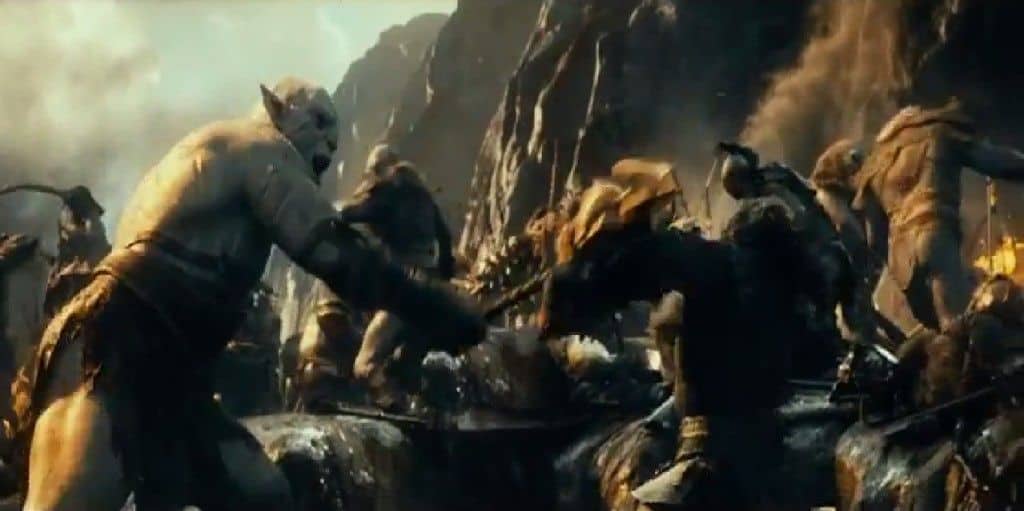
Tolkien wrote of The Lord of the Rings that "the tale grew in the telling." It was a mighty oak that grew from a humble seed; its essential largeness in comparison with The Hobbit is an important characteristic for both stories. So to see Jackson pump the shorter work up with air to match the longer one, one can't help but notice the stretch marks. There are more battles and the battles are often more elaborate than a reasonable reading of the source would allow; the scene with the trolls is the best example of this. The first time I watched this movie, I was somewhat disoriented by the action sequences, particularly in the hall of the Goblin King. This wasn't as much of a problem the second time around, but the frenetic and inflated quality of the battles just seems more alien from this story than it should.
But when swords are sheathed, An Unexpected Journey usually feels just about right. The early scenes in Hobbiton, where Bilbo finds himself suddenly besieged by guests, are fantastic. There's a fair amount of comedy in this movie; sometimes it's overly campy, like when Radagast the Brown touts his rabbit sled (???), but usually it's good-natured and jovial, with plates flying and songs being sung in keeping with the tone of the book. And the return of Andy Serkis as the voice and reference for Gollum is an unmistakeable highlight; riddles in the dark have never been more appropriately menacing. It's moments like that, preserving the tone of Tolkien's original work, that let Jackson and the rest's love of Middle Earth shine through more brightly. Those happier parts make for a damn good movie.
Basically, Jackson and his merry band have offered us what is plainly a handsome gift: another three years of Tolkien movies, wherein we can live amongst hobbits and elves and dwarves, contemplate the aesthetics of their languages and culture, and view hundreds of beautiful aerial shots of people walking across New Zealand while the orcish body count piles high. And frankly, we'd be fools to turn it down.
This is a very high-end, passionately made production, and to the extent that it fails, it does so out of a misguided ambition to match or exceed the spectacle of its predecessor. You have to give that a little respect. There are some things I don't like about it. I don't care for the unnecessary inclusion of Azog the Pale Orc. I don't like the fact that he so closely resembles Killface. I wish this were only a two-movie event. But the upshot of that is that Peter Jackson has two more movies to change my mind.
As for Peter Jackson, director of the Lord of the Rings film trilogy and the new Hobbit film trilogy, he clearly loves this stuff a lot. Maybe more than I do; I can never be sure. I only know that it takes a great deal of love, of that obsessive type we call fandom, to make three epic films on location at the same time, and then voluntarily do the same thing again a few years later. With an army of staff and cast to manage along with the weight of expectation, it must have been a gargantuan task that wore on him heavily. So regardless of any conceivable criticisms of any of these movies, let none question Peter Jackson's love of the source material: he is veritably King of the Nerds.
For those of us less advanced in the nerd hierarchy, Jackson's movies have been a gift of sorts. They take the delights of our imagination and transform them into spectacles for all to gather and enjoy. They can never replace the brilliance of their originals, but they can entertain us, and they can be shared more easily with friends and family who may not have the time or inclination to embrace Tolkien the way we do. If the movies have problems, that's unfortunate, but we will watch them and we will largely embrace them, because deep down we know that Jackson worked hard and wanted to make a good Hobbit adaptation just as much as we wanted to see one.
And there are problems with this movie. There are problems with the whole enterprise, really; problems we all foresaw, and which have come to pass before our eyes. I could understand the decision to film two Hobbit movies; Jackson's love for the material demands more than what can be gleaned from just The Hobbit, what with all the delicious lore packed away in Tolkien's less accessible writings. But we have a trilogy on our hands, ladies and gentlemen. We have an epic trilogy built from the frames of a children's book; a trilogy of three very long movies.
The effort to put The Lord of the Rings on film was enormous, and appropriately so, because it is a very long novel and shaping it into even three reasonably balanced films required an enormous amount of editorial discretion: hard choices about what to emphasize and what to change. Cranky nerds made sad noises at Arwen's expanded role in The Fellowship of the Ring, simply because it was different from what happened in the book. But because Arwen was to have an important role later on in the series, it made much more sense from a film making point of view to assign her the task of bringing Frodo to Rivendell than to introduce and then immediately forget about a character like Glorfindel. Changes like that make the movies more efficient and watchable, and are ultimately good decisions.
Putting The Hobbit into the form of an epic trilogy, on the other hand, absolutely requires addition. None of it is cut from whole cloth, being canonically based on Tolkien's writings, but it does dramatically change the nature of the work. The Hobbit: An Unexpected Journey feels like another episode of Jackson's first trilogy, but the original Hobbit did not feel like another chapter of Tolkien's larger book. It was never supposed to.
Tolkien wrote of The Lord of the Rings that "the tale grew in the telling." It was a mighty oak that grew from a humble seed; its essential largeness in comparison with The Hobbit is an important characteristic for both stories. So to see Jackson pump the shorter work up with air to match the longer one, one can't help but notice the stretch marks. There are more battles and the battles are often more elaborate than a reasonable reading of the source would allow; the scene with the trolls is the best example of this. The first time I watched this movie, I was somewhat disoriented by the action sequences, particularly in the hall of the Goblin King. This wasn't as much of a problem the second time around, but the frenetic and inflated quality of the battles just seems more alien from this story than it should.
But when swords are sheathed, An Unexpected Journey usually feels just about right. The early scenes in Hobbiton, where Bilbo finds himself suddenly besieged by guests, are fantastic. There's a fair amount of comedy in this movie; sometimes it's overly campy, like when Radagast the Brown touts his rabbit sled (???), but usually it's good-natured and jovial, with plates flying and songs being sung in keeping with the tone of the book. And the return of Andy Serkis as the voice and reference for Gollum is an unmistakeable highlight; riddles in the dark have never been more appropriately menacing. It's moments like that, preserving the tone of Tolkien's original work, that let Jackson and the rest's love of Middle Earth shine through more brightly. Those happier parts make for a damn good movie.
Basically, Jackson and his merry band have offered us what is plainly a handsome gift: another three years of Tolkien movies, wherein we can live amongst hobbits and elves and dwarves, contemplate the aesthetics of their languages and culture, and view hundreds of beautiful aerial shots of people walking across New Zealand while the orcish body count piles high. And frankly, we'd be fools to turn it down.
This is a very high-end, passionately made production, and to the extent that it fails, it does so out of a misguided ambition to match or exceed the spectacle of its predecessor. You have to give that a little respect. There are some things I don't like about it. I don't care for the unnecessary inclusion of Azog the Pale Orc. I don't like the fact that he so closely resembles Killface. I wish this were only a two-movie event. But the upshot of that is that Peter Jackson has two more movies to change my mind.
Subscribe to:
Posts (Atom)