Saturday, February 16, 2013

Album Review - Toys

If you play with certain toys long enough, they develop a kind of independence that isn't easily explained.  At least I remember it that way; I had legos and action figures that "did"  things, under the power of my hands, but not necessarily of my will.  Children supposedly make up stories about their toys, but something in those toys always seems to suggest the logical course of those stories.  Looking back, that seems a little scary.

It's that dangerous feeling of not being fully in control of my imagination that dominates my experience with Toys, by Timothy McGaw.  It calls up childhood like it never left and invites it back to play, on somewhat more sophisticated grounds than before.  The result is a delightfully eccentric thirty seven minutes of niche pop.

Toys is a concept album about childhood that celebrates that time of life without dumbing itself down; it's the aural equivalent of an expedition to the attic where your parents used to hide the Christmas presents, or any of the other nooks and crannies that fascinated us as children.  Adults can look back on those times and be amazed, not only by the mysteries themselves but by their own amazement. 

Most of what makes Toys tick is the arrangements, which chart a broad spread of moods.  From joyful abandon to suspicious dread, accompanied always by innocent curiosity, emotions stand front and center on this album.  They come in bright colors on the strains of unusual instruments, and take on lives of their own; most of these songs move freely in and out of traditional pop structures.

About a quarter of the tracks are instrumental, and many of the songs with vocals have pronounced instrumental sections; McGaw's talent as an arranger keeps these moments vital and listenable.  The entire album flows together with clever segues and transitions, and bits of melody are reprised throughout.  Toys is well-planned and executed brilliantly; there's nothing extraneous to distract from the main idea.

McGaw has a good singing voice; not an intrinsically great one, but used effectively and placed well in the context of his songs.  Multi-tracked harmonies and standout melodies (particularly on the songs "I Just Want to Go Home" and "Rivals") imbue Toys with the relaxed vibe of a vocal band like the Beach Boys, though to my knowledge he's singing all the parts himself.

In fact, McGaw is a self-professed fan of Brian Wilson and the Beach Boys, and their influence extends beyond his not-infrequent use of falsetto.  The presence of unconventional instruments like harpsichords, jaw harps, and bass harmonicas, alongside strong melodic bass lines, gives Toys a kind of family resemblance with Wilson's production masterpieces, Smile and Pet Sounds.  The instrumental "Daydreaming of Other Places," in particular, is strongly reminiscent of the Pet Sounds track "Let's Go Away For a While."  None of this is to imply that McGaw lacks originality; his own sense of humor is highly evident in every song.  This is just the tradition he's working in: retro, colorful, and supremely joy-oriented, even when it grapples with darkness.

Toys is McGaw's debut album, produced and released independently and available (so far) only in digital form.  I think I was lucky to find it; this album has been out for less than a month, and it is probably unlikely to rocket to the top of the charts.  But it's beautiful and sweet, and it deserves to be heard; anyone who ever had a childish imagination could find something to relate to here.  With Spotify or a digital music store like iTunes, access is easy, but sadly it must compete for attention.

Consuming and listening to music can be about absorbing whatever happens to be in the air around you, or it can be about chance discovery and taking risks.  Believe me, in this case the latter is worth the effort.

Wednesday, February 13, 2013

Thoughts on Drones

I decided I would write an essay called "thoughts on drones," because as we enter a time of their increasing presence, all of us would do well to think more about them.  Drones are a military matter, but the experience of history tells us that we should never trust the judgment of the military as a matter of course.  These issues require careful thought.  In that sense, they are not unique, but we as a nation could certainly use the practice.

By drones, of course, I am referring to the unmanned aerial vehicles owned by the government.  In principle, a drone is no different from an airplane or a helicopter; it flies according to the same physics and is subject to the same basic limitations.  The key difference is that a drone does not carry people; it is controlled by radio from the ground, but in many cases can perform many of its functions autonomously, via programming and artificial intelligence.

Does that frighten you?  It's an important question.  We're all generally familiar with nightmare science fiction scenarios: robots possessed of consciousness and intelligence rising up to destroy us on capricious whim.  Even the idea that their most important (and often lethal) functions are under the control of the military or the police is suggestive of dystopian visions of futuristic totalitarian states, where the machines represent the iron force of a corrupt humanity.  Symbolism and fiction stoke our imaginations, and our imaginations can bewilder us and cause panic.

So before you can form a meaningful opinion, you must be sure of whether or not you are afraid of the drone.  Consider carefully.

The cause for fear is not only cultural: the use of drones in Pakistan and elsewhere has demonstrated their efficacy in killing, and their utility for spying is self-evident.  On top of that, the Obama administration has seemingly claimed the right to use drones to target and kill "enemy combatants" without due process, even if they are Americans.  The notion of such a machine firing a missile at a criminal suspect in the United States may seem so dramatic and outrageous as to be nearly unthinkable, but there is a line of logic that could lead to such a policy.  It's within the technical capability of the government, and a firmly and clearly stated policy prohibiting it would do a lot to allay concerns.

Sadly, the government seems to be opting for more ambiguity on the drone issue.  Obama's words imply he supports limits on the program, but no meaningful limits exist; or if they do, we aren't allowed to know what they are.  That has to change: we can't hold the government accountable to its own rules if the rules are secret.

But in spite of all that, I find the notion of drones as the instruments of a new totalitarianism to be slightly overblown.  Virtually everything the government does has been decried as Nazism or Stalinism by somebody, ever since those words were first uttered.  Many things the government has done have been outrageously wrong or illegal, but it betrays the privileged historical perspective of Americans that they can compare minute increases in the tax rates of the rich to storm troopers and extermination camps, all with a straight face. We cry oppression too easily in the face of abstract possibilities, while we ignore it in the actual fact of systemic poverty and police brutality.

Obviously, a fleet of drones could be used to control a fascist nightmare society through violence and surveillance.  It could also be used for legitimate and useful functions, especially with regard to searches for people in trouble, or dangerous criminals on the run.  Much was made this week about mass shooter Christopher Dorner being the "first American on U.S. soil to be targeted by drones," a claim that now appears to be untrue.  But even if he were being hunted by a drone, would it have been any more problematic than using a helicopter for aerial searches?  Does the use of drones in police actions really introduce new problems, or does it just add new dimensions to old ones?

As for the problem of drones acting autonomously, I find it hard to take that seriously.  A drone that could initiate a Skynet-style campaign of its own volition is clearly not something that the government would ever allow in the air, and a random misfire is probably a very low risk, compared to all the other risks that exist.

So far as I'm concerned, I don't fear drones, any more than I fear the already considerable powers of the government to use force against the people.  They are a potent symbol of dangerous possibility, but I don't think they introduce that much more actual risk to our lives than overzealous cops or muddy, ambiguous policies.

My thoughts are guided by the assumption (and it is only an assumption) that the government means to act in good faith; that though it may be wrong and misguided, it is trying to make our lives better.  That it may fail catastrophically is precisely the reason we are supposed to have oversight over it. 

I don't like armed drones, any more than I like bombers or nuclear missiles.  But in a realist examination of the requirements of a modern military, I can't exactly blame drones for existing, or deny their legitimate uses.  They're all part and parcel of the same old military-industrial complex we've had all along, and the same set of shoulds apply as they always have: more oversight, fewer wars, and less money diverted from vital domestic needs.  Drones are the newest thing, but they are not unique, and they don't change the basic equation we've faced for decades.

Sunday, February 3, 2013

WFJ Book Club #10: Malachy McCourt's History of Ireland

Before there was history there was oral tradition, and historians will be sure to tell you that they are very different things.  The modern practice of history aspires to scientific accuracy, distinguishing clearly between facts and fictions, and sometimes sacrificing simple clarity for the sake of a more complete understanding of the past.

The oral tradition, on the other hand, arose from the human love of storytelling and consequently is much more tolerant of "facts" which cannot be substantiated.  We tell stories to get at a different kind of truth, the kind that conforms to our expectations of how the world works: that the lives of people and countries have beginnings, middles, and destinies.  Oral tradition forcefully implies not only that we've come from somewhere, but that we're going somewhere too.

Malachy McCourt's History of Ireland does not present these two traditions as incompatible with one another, and the history is a better read for that.  McCourt introduces his book by invoking Peig Sayers, the great storyteller of the Irish language in modern times, and placing himself in her tradition of preserving traditional stories and culture.  But the book is thoroughly researched and broad in scope, and does not allow itself to get bogged down in one perspective. 

Divided into a series of biographies of notable Irish men and women, McCourt makes a number of special claims about Irish history.  He promotes a familiar romantic notion of Ireland as a land of heroes of all stripes: not only warriors and politicians, but also writers, artists, and poets, and many otherwise less-exalted types.  Irish culture is heroic, and Irish people (both male and female) are singled out for acts of uncommon patriotism, wisdom, and courage.  Ireland itself is heroic, passing as it has under English domination to a new age of freedom, though it still has a legacy of sectarian violence to confront.

In telling the lives of these heroes, the book freely introduces legend and anecdote into what would otherwise be a straight historical narrative.  This happens particularly in the early chapters, which essentially are just legends, from Ireland's prehistorical period.  As the documentation grows more prominent, colorful anecdotes still work their way into the story in a free and unobtrusive way, but McCourt retains a healthy respect for the distinction between fact and fiction.  Often he will shrug off the incongruity with a wry observation that, true or not, a little myth certainly makes for a better story.

I was particularly pleased to find among Ireland's gallery of heroes a healthy sampling of women: famous and strong willed ladies like Grace O'Malley, Maud Gonne, and Bernadette Devlin, among others.  The author praises these women for their boldness and their unique contributions to history, noting that independent woman are in keeping with Ireland's independent national character.  His descriptions of ancient Ireland as something of a proto-feminist exemplar (at least in comparison to mainland Europe) stretch credulity at times, but it does fit in with the larger theme that Ireland is a heroic country, and that heroism comes from all quarters.

Ireland is a storytelling nation, and has been for a very, very long time; this is the book's great premise, and it's a little bit overstated.  After all, virtually every country on Earth has a storytelling tradition and a love of its own history.  But there's no denying that Irish stories come with a particular flavor and that the Irish people are very proud of it.  That pride is very seductive, and if you've got Irish heritage (like I do) then I imagine you're bound to get wrapped up in the underdog's story.  The loss of political liberty chipped away for centuries at Ireland's native language, customs, and identity, but in spite of that all those things are alive today; it's an inspiring tale.

As I mentioned, the historical narrative is mostly conveyed as a series of short biographies, and many of these could easily be read as independent essays.  The consequence of that is that many incidents and events, relevant to the lives of more than one person, are related more than once in a notably repetitive fashion.  For someone used to scholarly, straightforward biography or history, too much repetition can be tiresome.  But in the tradition of Peig Sayers, a little incidental repetition from story to story is a virtue for the listener: it ties events together in a way that emphasizes their interconnectedness.  And again, as far as Malachy McCourt is concerned, there's no point in sacrificing the virtues of a good story. 

The conventions of Irish writing and orthography are not intuitive to most English speakers, so a comprehensive pronunciation guide for many of the names and places mentioned would have been a blessing for the readers.  Instead, we've got to make whatever sense we can out of the names; it is my fervent hope that not too many people ever ask me to pronounce a name like CĂșchulainn out loud (at least until I've had time to learn Irish).  But in spite of some pronunciation questions it really is an accessible book with a lot to offer anyone with an interest in Irish history.

Monday, December 31, 2012

Scribbles: Unfinished Business

With the year 2012 fast approaching its conclusion, I think the moment calls for a little unfinished business.  Some people have resolutions.  I have them too, but I'm only going to share one with you now: write more.  A lot more.

Here's some poem-type stuff I found in my binder, most of it unfinished until I took the time to give them the tender loving completion they deserve.  Now that they're out of the way, I have even less excuse to put off writing more new things.  Onward, 2013!

Success

Another day and month
I search without success;
but there,
a woman drifting through the air
and something makes my heart grow fonder,
something makes my heart respond
with hammer blows on beaten bells,
a hole inside me fills and swells
with satisfaction now,
a measure of success.

Woad

I paint with woad because it's older,
indigo is much too blue;
I'd drown in all its saturation,
older dyes will surely do.

I paint my face and stain my clothes
because it's as I've always done,
and nothing drives me harder
than traditions I've begun.

I'd brush away the new beginnings
and delay the modern trends,
but I must regret in silence
when traditions have to end.

Please Stay Away

You haven't aged a moment:
go away, go away.
I would like you to stay for an hour,
look me deep inside my eyes
and say your peace, and
go away, go away;
please stay where I can see you,
out of reach,
go away.

A Toxic Situation

No one wants to hear you whisper,
they're all hear to watch you scream at me;
they want to hear it nice and loud.

They came to see a show, but
I don't think you want to give one,
I don't think you want a single thing
except to make me fight with you.

I'm sick of how you bother me for nothing;
you want nothing?  I'll be happy to oblige.

Cold and Cracking

I always wind up crazy
when my lover's not around
because I don't know what I'd do if she were here.

I'll freeze to death in ages
without sunlight on my skin,
just a lonely ray of sun to bring her near.

To You

To one who laughs and rhymes with love and sound,
who echoes in the warmth of every night
like music in the stillness all around,
her melody a banner waving bright,

To lightning in the quiet of the morning,
to one who sees with fresh and gentle eyes
the worth and me and all we have to offer,
sweet hellos and bittersweet goodbyes,

To you, my love, I'm finally coming home.

__________

...

OK, they may not all be my best work.  But some of them are pretty good.

Now, On to the future!

Friday, December 28, 2012

The Hobbit: An Unexpected Journey

I've been a fan of J. R. R. Tolkien's Middle Earth for a very long time; even from before I really knew why.  My very young self was probably drawn to the sword craft and high adventure, identifying with the Hobbits Bilbo and Frodo as they discovered a series of incredible experiences.  It was only after repeated re-readings (I once read the entirety of The Lord of the Rings and The Hobbit in less than a week, simply to prove I could) and further exploration of the lore surrounding Professor Tolkien's life and work that I began to understand its true allure.  Tolkien wrote with a genuine passion that went beyond telling one story.  He used every element at his disposal, from geography and mythology to his beloved philology, to animate the world beyond the story and create a realm of legend.  It sounds dreamy and nerdy, because it is; Tolkien loved the world he wrote about in all of its minutiae, the way only a true nerd could.  

As for Peter Jackson, director of the Lord of the Rings film trilogy and the new Hobbit film trilogy, he clearly loves this stuff a lot.  Maybe more than I do; I can never be sure.  I only know that it takes a great deal of love, of that obsessive type we call fandom, to make three epic films on location at the same time, and then voluntarily do the same thing again a few years later. With an army of staff and cast to manage along with the weight of expectation, it must have been a gargantuan task that wore on him heavily.  So regardless of any conceivable criticisms of any of these movies, let none question Peter Jackson's love of the source material: he is veritably King of the Nerds.

For those of us less advanced in the nerd hierarchy, Jackson's movies have been a gift of sorts.  They take the delights of our imagination and transform them into spectacles for all to gather and enjoy.  They can never replace the brilliance of their originals, but they can entertain us, and they can be shared more easily with friends and family who may not have the time or inclination to embrace Tolkien the way we do.  If the movies have problems, that's unfortunate, but we will watch them and we will largely embrace them, because deep down we know that Jackson worked hard and wanted to make a good Hobbit adaptation just as much as we wanted to see one.

And there are problems with this movie.  There are problems with the whole enterprise, really; problems we all foresaw, and which have come to pass before our eyes.  I could understand the decision to film two Hobbit movies; Jackson's love for the material demands more than what can be gleaned from just The Hobbit, what with all the delicious lore packed away in Tolkien's less accessible writings.  But we have a trilogy on our hands, ladies and gentlemen.  We have an epic trilogy built from the frames of a children's book; a trilogy of three very long movies.

The effort to put The Lord of the Rings on film was enormous, and appropriately so, because it is a very long novel and shaping it into even three reasonably balanced films required an enormous amount of editorial discretion: hard choices about what to emphasize and what to change.  Cranky nerds made sad noises at Arwen's expanded role in The Fellowship of the Ring, simply because it was different from what happened in the book.  But because Arwen was to have an important role later on in the series, it made much more sense from a film making point of view to assign her the task of bringing Frodo to Rivendell than to introduce and then immediately forget about a character like Glorfindel.  Changes like that make the movies more efficient and watchable, and are ultimately good decisions.

Putting The Hobbit into the form of an epic trilogy, on the other hand, absolutely requires addition.  None of it is cut from whole cloth, being canonically based on Tolkien's writings, but it does dramatically change the nature of the work.  The Hobbit: An Unexpected Journey feels like another episode of Jackson's first trilogy, but the original Hobbit did not feel like another chapter of Tolkien's larger book.  It was never supposed to.

Tolkien wrote of The Lord of the Rings that "the tale grew in the telling."  It was a mighty oak that grew from a humble seed; its essential largeness in comparison with The Hobbit is an important characteristic for both stories.  So to see Jackson pump the shorter work up with air to match the longer one, one can't help but notice the stretch marks.  There are more battles and the battles are often more elaborate than a reasonable reading of the source would allow; the scene with the trolls is the best example of this.  The first time I watched this movie, I was somewhat disoriented by the action sequences, particularly in the hall of the Goblin King.  This wasn't as much of a problem the second time around, but the frenetic and inflated quality of the battles just seems more alien from this story than it should.

But when swords are sheathed, An Unexpected Journey usually feels just about right.  The early scenes in Hobbiton, where Bilbo finds himself suddenly besieged by guests, are fantastic.  There's a fair amount of comedy in this movie; sometimes it's overly campy, like when Radagast the Brown touts his rabbit sled (???), but usually it's good-natured and jovial, with plates flying and songs being sung in keeping with the tone of the book.  And the return of Andy Serkis as the voice and reference for Gollum is an unmistakeable highlight; riddles in the dark have never been more appropriately menacing.  It's moments like that, preserving the tone of Tolkien's original work, that let Jackson and the rest's love of Middle Earth shine through more brightly. Those happier parts make for a damn good movie.

Basically, Jackson and his merry band have offered us what is plainly a handsome gift: another three years of Tolkien movies, wherein we can live amongst hobbits and elves and dwarves, contemplate the aesthetics of their languages and culture, and view hundreds of beautiful aerial shots of people walking across New Zealand while the orcish body count piles high.  And frankly, we'd be fools to turn it down.

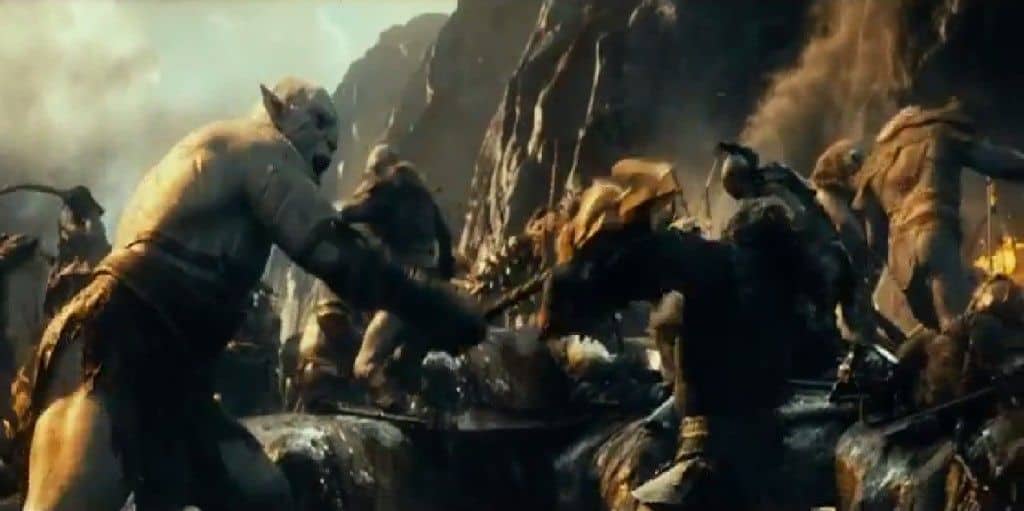
This is a very high-end, passionately made production, and to the extent that it fails, it does so out of a misguided ambition to match or exceed the spectacle of its predecessor.  You have to give that a little respect.  There are some things I don't like about it.  I don't care for the unnecessary inclusion of Azog the Pale Orc.  I don't like the fact that he so closely resembles Killface.  I wish this were only a two-movie event.  But the upshot of that is that Peter Jackson has two more movies to change my mind.

Tuesday, November 27, 2012

Poetry Jam #10

That number is not a lie.  I've done this ten times, ladies and gentlemen: my poetical impulse cannot be contained by mere single-digit numbers.  It will take more than nines to stop me, I fear.

Tonight's poems come from the period of Autumn of 2011 through approximately Summer of 2012; quite recent, by the standards I have on this site.  I have reached a point where I have a certain degree of confidence in my poetry that I did not always have.  Namely, I feel confident in stating that my work actually is poetry, and not a clumsy pile of the worst  affronts to the very idea of poetry.  I've put on a brave face this whole time, but some of my earlier work is questionable in that regard.

So, it's poetry.  Is it good poetry?  I'm pretty sure I'm not allowed to say.  If someone would like to tell me, I'd really appreciate it.  In the meantime, enjoy Poetry Jam #10.  Several other poems from the same time frame are in my folder and on my desk top, in states I consider to be fragmentary or otherwise incomplete.  I see promise in many of them, so I'd like to finish them, but for now we have the following to consider:


Happily

Welcome to Monday; you're six hours late and the
sun is unfazed by the schedule you're keeping.
she's halfway across and you've only been sleeping, 
so drink all your coffee and be on your way,
happily lonely and happily driving away.

Open your eyes if you want to see clearly.  You
won't see the sun if you're happily dreaming,
she'll fly by the clouds with her countenance beaming;
you'll never be certain to see her in time.
smile, don't mention you're happily losing your mind.


Child

Am I a child?
Am I young and immature?
A wild and wide-eyed innocent,
A messy pile on the floor;
Do I feel alive and hurt
Or am I dumb and bored?

A child grows, and what's a grown-up for?
The children want to know;

Am I a child,
An uncompleted work of life?
Am I growing up or down
Or standing still?
Am I just a vessel filled
With questions, needs and wills?

A child grows, and what's a child for?
The children never know.

Am I a child,
Will I grow?
Have I grown too much?
Am I such a mystery
I cannot solve myself?


The Iris and the Shell

An iris and a little shell, dissolving
in a million bits of violet light;
I see them in the future, and I know
it's coming soon. They're coloring the night
and painting pictures with the falling stars,
illuminated indigo and white.

Powdered into diamond dust and ground
into a pigment, dark and dimming blue;
I see them in the future and I wonder,
if I see them, can you see them too?
All spread across the water?  Hanging in
the evening breeze, embellishing the dew?

Can you see the future, see it blinking
in the sun?  The iris, rising tall
and growing stronger in the little shell?
I see it; it is beautiful, and all
the words I know could not do justice to
its grace. I'd like to watch its petals fall,

To see it standing bare until the spring
returns; I want to know the blossoms' smell.
Their future is a supernova burst,
their voices like a shining crystal bell:
Now, can you see them be reborn in cosmic
bloom, the heavens' iris-colored shell?


Locked Out

My hand is numb from cold, and fire
burns my feet: my reach exceeds
my grasp.
Too scared to fail, too dumb to win;
too shaken up to feel secure.
In fact I can't remember when
I felt secure, or why I did;
it seems so silly now, to think
I might have felt like I was safe.
Today I'm lonely, lost at sea,
I'm isolated, up a creek.
I can't remember what to do
or how to do what needs be done.
And who can help me? Can she help?
I think that she's the key, but she
is locked inside the cabinet,
and where's the other key?  I left
it somewhere, but I've lost it now.

Who keeps the key?  Who makes the rules
that govern love and emptiness?
Who locks the lonely people out
and offers them excuses? Says
"the door was never locked, in fact
the cabinet is open wide,
and all you need to do is reach
your hand out, grab the key and turn."
But who is grabbed?  I feel sick,
like something's got me by the lungs.
Too little air; the window's locked,
Is she the key?  And can she see
me on this side?  Both panes of glass
are foggy, and I'd like to clean
them, but I'm scared they'll break.


The End of the World Will Not be Violent

The end of the world will not be violent,
baked in blood and burnt;
the Earth won't shake.

For the world will end in a whisper,
in a quiet lullaby of birds
who sing of longing and laughter, as they fall asleep
and dream of sunny skies.

The stars will pierce the atmosphere
to dissipate the clouds from great distances,
and soon they'll disappear,
to lay the pearly heavens bare.

The birds will start to snore
as their nests grow deeper and deeper,
and the skies grow starker and starker
and merge in one great sky
the likes of which has never been seen above our heads before.

Unseen it will grow and the Earth will end
as it shrinks.

The silence will be cool, and glow
with gentle light;
a nightlight for the sleeping birds
who dream of sunny skies,
that once upon a time
combined in one great sky.


One More Year

I think I've got a year to live;
if nothing turns out horribly wrong,
explodes in my kitchen, burns my lawn,
or breaks into a million pieces on
the sidewalk curb,
I think I can make it that long.

I think I've got a year to go
to London, Mars, or somewhere gone,
to fall asleep with only a yawn,
to find myself awake at dawn
and pass a dream;
I'd like to live that long.

I think I've got a beautiful year
to write a very beautiful song,
and sing it to a cheering throng,
and learn to sing it like I belong
on stage at all;
I hope I can make it that long.


City of Angels

I'll see you in the city of angels,
a dirty place I'd never like to see
again; a place for killing dreams and schemes
that hatched too soon.  I'll see you there,

in months or years, at somebody's party;
I don't know why I'd be there, but I know
I'll be there soon.  I read the invitation:
"Come at once and bring your money, all

the money you can spend in an evening."
I'll bring the most but you'll have more; before
I know it you'll have spent me, I'll be spent
and lying on the floor, crying for

you, falling for the city of angels.
In dirty tears, in dirty thoughts, in pain
and lots of others, feeling bolts of light
and arrows in my bones.  I'm all alone,

the party's slowly tapering down
and now you're out the window in your Euro-
diamond car, off to paint some sketchy,
filthy, unhygienic bar a deep,

disturbing, healthy lavender-red.
I watch you speeding down the boulevard
and watch the guards patrol the streets below,
forever mindful of disruptions: guns

and needles in the city of angels.
It worries me to think that you're so good
at this; I wonder if I pegged you wrong,
as wandering shadows dirty up the walls.


Feeble Falling Snow

I watch the feeble falling snow outside;
it sits upon the ground in pools of water,
melts before it settles down to touch the street. 

It chills the air across the window,
fogs the pane outside and melts away,
like every other flake of ice that falls at thirty three degrees. 

The snow above,
the rain below,
the crystals frozen in the gutter;
nothing cleaves to mist and dew,
It slips and slides across the frosty glass.


The Huntsman Dying in the Snow

West of the midnight sun,
the lightning strikes the huntsman as he
watches the caribou run
across the grass and snow.
 
Under the arctic sun
he lies, alone and smoking whispers
into the said and done,
and hearing no response.

East of the evening sun,
the sky is falling on the huntsman's
body, and one by one
the stars announce the night.


A Beautiful Life

A beautiful life in forests and fields,
cars and trucks,
the highways bound for bigger towns,
and Radiohead on the radio.

Hand in hand between the hills, the
melting ice;
the wind still sends the air below
that warms at the sound of our voices.

By mossy jeeps and the resting timber,
rivers run
beneath the slopes of green and snow,
by wheels on the slippery road.

On a whim we stop, and taste a memory,
drink a cup;
the winter on a country drive
will carry us, bringing us home.


Light the Way

Light the way, I'll follow you,
I'll walk across the city streets
if you'll be on the other side;
light the way and I'll be there beside you.

Light the way beneath the stars
with lamps along the sleepy streets,
and take the darkness from the sky;
share the light that reaches out and scatters.

Light the way that brings me home,
and if you hurry we will meet
where scattered lights have come to rest;
Come together, living all around us.


Underpass

This concrete wall is bigger than me,
this bridge extends indefinitely
as far as I can see;
I am as small as anything
that I have ever known,
smaller than the dirt below
my feet and infinitely tiny
in comparison to this,
the work of your machines.


The Road Looks Like a River

The road looks like a river today,
with droplets sparkling on the black
like ripples,
and tires sinking under the surface,
under the sinking tar.

The road looks like a river
running over,
the cars are underwater and the
lights shine from below
like a graveyard of lost ships
descending home.

The river is alive!
The ripples dance across the hoods
and hail,
hail the breaking cloud
and split the surface of the black
in grains of sinking tar.


You Are So Young

Your face is laughing
and you are so young,
your heart beats faster,
seconds faster than mine can beat.

I've had enough of
this walking along;
Let's take our shot a
hundred miles and years from here!

Now nothing makes me
believe in my heart
like you: you send me
far from here and far along.

But why should I be
so eager to fly,
when you are here and
we're together on solid ground?

And why should I
surrender this day
when you are here and
sunshine glows in the open air?

Your face is laughing
and you are so young;


Music and Lyrics

I believe in a word of love
and hope, because it sounds like bells
when spoken, melts like water, cools
and cleans me, makes me think of you.

I believe in the light of music,
twice reflected in your eyes
as lightning in a sky of diamonds,
music and lyrics by one and two.


Hot Ink

The ink was hot, its fire spread across
a thousand books, and arson was the crime.

The knowledge, grace and beautiful words that rang
like keys were lost when the music burned to ashes
and the ink was poured on vulnerable heads.

A history was written in their place;
an inky darkness scorched across their pages.

_____

Commentary is unavoidable.  Prepare for it!

Happily and Child both find me in a state of self-doubt, familiar to those familiar with my poetical works.  I don't think Child came out the way it originally sounded in my head, but I can hardly remember how it sounded way back then.  I just tried to be honest.

I wrote The Iris and the Shell in a more or less transparent attempt to impress a girl I was seeing last October.  We'd been on a few dates and I liked her, but I sensed that she was not exactly enraptured with me.  So I spent days crafting this poem, to provide some evidence of my value as a thinking, feeling person who could do at least one thing well.  As it happened, she never read it because I never saw her again, but the loss did not plunge me into my usual bout of despair and depression.  True, Locked Out came out of that period, and it's pretty depressing, but all in all I came out of that one alright.

The End of the World Will Not be Violent and One More Year are further indulgences in my obsession with what I privately call mellow apocalyptica, a word I apparently made up.  To wit: we're all doomed, but it might be kind of pretty when we go.  I guess I think about things like that as the year comes to an end.

I was ridiculously proud of City of Angels when I wrote it, and I still think it's pretty damn awesome.  It's also a fact that I thought it up while slightly drunk at four in the morning, wondering what an ex-girlfriend I hadn't seen in years was up to at that very moment.  Through bleary eyes, I saw that the hastily improvised meter worked, and it made me smile.  In the morning I realized I had been absolutely insane: in all likelihood she was just sleeping, like I and all ostensibly sane people should have been doing at four in the morning.  But it still works as a panicky nightmare piece.  That's valid, right?

I wrote two poems in quick succession about snow, which is only fair because it was winter and snow was on my mind.  I like living in a place where it snows, though it doesn't always come in the kind of fluffy blankets you see on Christmas cards; hence, Feeble Falling Snow.  As for Huntsman, it just seems I can't do anything without being at least a little depressing, but I think I came up with some good turns of phrase here.

A Beautiful Life, Light the Way, You Are So Young, and Music and Lyrics are my favorite poems in today's collection.  All of these poems were written for and inspired by my beloved girlfriend, Tara, whom I met in January and has transformed my life into a field of lollipops and other delightful treats.  The first two came early, and in fact I gave a copy of Light the Way to her as a St. Valentine's Day present.  I'm such a smoothie!    I composed Music and Lyrics during a prep period while working as a substitute teacher in a history classroom.  The lesson consisted mostly of showing a video, so I thought it was the best possible use of my time.  Thus far, Tara has only seen those two, so I present the others to you and to her with all of my love.

Underpass is a lot shorter than the others here, but it expresses a very simple idea that came to me while I was walking under a bridge.  It really doesn't need to be any more than it is, and I really like it as is.

Hot Ink is a metaphorical sort of thing, the sort of poem one writes when trying to be very serious about something important without wanting to seem overly transparent.  Why be transparent when you can be arty?

Wednesday, November 21, 2012

Thanksgiving in Patuxet

Tomorrow, Americans will come together all over the country to feast and enjoy the company of family (to the extent that they do not wish to avoid them).  Many of them will say prayers and publicly express gratitude for the good things in their lives.  Many of the meals they share will be absolutely delicious, but some of them may disappoint.  Some people will overeat, and some will come away grateful that Thanksgiving only comes once a year.  Despite these shortcomings, I consider these gatherings to be a good thing.

However, these are not the only shortcomings to consider.  Because Thanksgiving, as it is practiced, is more than a time to gather and be with family.  It comes complete with a national origin myth, which is taught to every school child and invoked in decorations and other pageantry.  We are told of the brave Pilgrims who, bearing the twin beacons of Christianity and democracy, landed by chance on Plymouth Rock and established a colony.  They befriended the local Indians (remember Squanto?) who helped them survive the first winter; the Pilgrims set about bringing culture and civilization to the harsh landscape.  After that first year, all parties involved sat down for a glorious feast, thus beginning an unbroken tradition of thankfulness that we carry on today.

A lot of this is crap.

It's extremely easy to go through life in America and never see this kindergarten version of history seriously contradicted (by which I mean, contradicted by someone you take seriously).  But it's also fairly easy to find the truth of the matter if you are willing to look for it.  You could use the internet, or even read a few books.  To make sure I had all the important facts for this post, I turned today to an old favorite: James W. Loewen's Lies My Teacher Told Me.  I thought it would be worthwhile to revisit this information and share it with the people of this country.

To begin with, it bears repeating that in historical terms, the Pilgrims were relatively unimportant.  Plymouth was hardly the first European colony, nor even in the top ten.  Jamestown was already up and running in Virginia, and the Spanish, French and Dutch had been planting colonies for a long time previously.  Europeans were already living on land that would later be part of the United States, in sites and communities that exist in continuity with the present day.  And of course, there were tens of millions of Native Americans living there already, many of them in permanent or seasonal settlements.  Plymouth itself was eventually absorbed into another colony.  So treating the establishment of Plymouth as our founding moment is bizarre at best, and actively biased in favor of religious Englishmen at worst.

Hardly anything the Pilgrims did was a historical "first;" not even the First Thanksgiving.  This is not a truly controversial assertion: harvest festivals are common in many countries around the world.  The timing and iconography of Thanksgiving makes it very plain that it is in essence a harvest festival, and the Pilgrims certainly held one in conjunction with the Native Americans.  But when Abraham Lincoln first established Thanksgiving as an annual federal holiday, he made no mention of the Pilgrims: declaring days of "thanksgiving" on an ad hoc basis had a long history  that preceded the Pilgrims.  According to Loewen's book, the Plymouth Rock story wasn't a part of the national holiday lore until the 1890s.

Thanksgiving is often touted as a celebration of a time when the Natives and the Pilgrims came together in harmony, the implication being that this harmony has defined our nation in some essential way.  It hasn't, of course: the Native Americans have been systematically killed and displaced from every corner of this country they originally inhabited.  The Pilgrims were gentler than most, but they represented the same general pattern: the encroachment of Europeans on land that was already populated, while treating it as though it were empty.

In fact, the biggest single piece of assistance the natives of New England gave to the Pilgrims was dying in droves of small pox.  Across the continent, European diseases had wiped out more than 90% of the indigenous population, a decline from more than ten million people.  The earliest European explorers wrote about industrious villages and even cities throughout North America.  These were drastically depopulated by the plague, and when the Pilgrims came to Cape Cod, they built their colony literally (quite literally) on the abandoned ruins of Squanto's hometown.  That town had an advantageous position on the harbor, which the natives had taken full advantage of for fishing.  There were permanent buildings and fields where corn was grown.  The name of this town was Patuxet, until the Pilgrims renamed it "New Plimoth."  Had the people of Patuxet not been decimated in a plague, they might not have been so accommodating to the newcomers.

Patuxet is not unique: the Americas are full of European settlements on the sites of indigenous towns and cities, not all of which were depopulated when Europeans "discovered" them.  But the Indians of the Thanksgiving mythos can hardly be said to have towns: they have been characterized as nomads who lived primitive, uncivilized, unproductive lives.  This is not true.  They were farmers, and fishermen, and craftsmen.  They lived differently from Europeans, but they were civilized.  Nevertheless, the descendents of those Europeans, who seldom bathed and looted the graves of natives for valuables, have painted them for posterity as savages who should be grateful for the arrival of "modernity" on their shores.

Let's bring this back to Thanksgiving, as it is celebrated today.  The holiday is a treasured part of life for many of us.  Tomorrow, I will take the opportunity to grow closer to my girlfriend and her family, an opportunity for which I truly am grateful.  I will eat the turkey, the mashed potatoes, and the gravy; God willing, it will be absolutely delicious.

But for the sake of truth and justice, can we knock it off with the Pilgrim/Indian iconography?  Can we stop treating the history of our country as if it revolves around a positive relationship between two peoples that never really existed?  Can we give indigenous people a break by not treating them as characters in a diorama, but rather as dignified humans with legitimate historical grievances? 

Can we stop treating the early history of the American colonies like a forgotten passage of the Bible?  I don't know if we can.  Americans (particularly white ones) view history as an opportunity to justify our past as an ascendant path toward exceptional greatness.  They see the hand of God in this, and they always have: most Europeans in the 17th century believed that the plagues which killed the native people of America were an explicit invitation from God to move in.  Nowadays we've forgotten even that, and we imagine that this continent was gifted to us in a pristine, mostly empty state.  It wasn't: it was opportunistically seized.

We'd do best to forget everything we think we know about "the First Thanksgiving" and learn to respect the experience of Native Americans.  Do a little research and learn about the real history of this country, whether it's in books like Loewen's or on (reputable) sites around the internet.  Some of it you will like, and some of it you won't, but in either case you'll learn infinitely more than what schools have seen fit to teach you.

There's no reason to go on with the pageants and the the buckles and the feathered headdresses.   They do nothing for school children except to turn them into close-minded adults.  They do nothing for adults except to keep their minds closed. 

Thanksgiving doesn't have to be about identifying our multicultural nation with an insular band of religious separatists and their quest to populate a "new world."  Neither does it have to be about removing embarrassing realities from our history.  It can and should be about humility and gratitude.  That's the spirit with which I intend to treat it tomorrow.